For far too long, the Dark Ages remained unjustly underexposed. Researchers at Ghent University are now changing that. They combined all knowledge about the early Middle Ages in a research review.
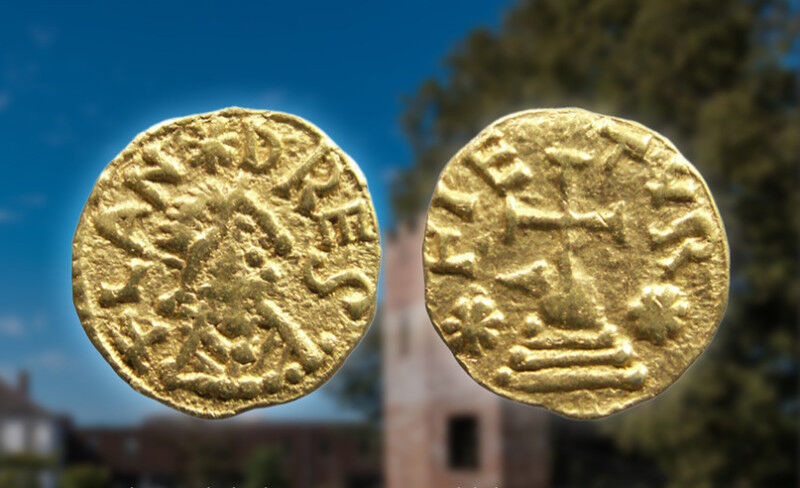
A gold coin with the inscription "FIETUR FLANDRES" ("made in Flanders"), the first wooden churches, farmyards that form the beginnings of a village, widely varying types of pottery, Merovingian graves: all recent archaeological finds in Flanders that tell us more about the early Middle Ages. A period traditionally characterized as "dark" and "barbaric" (the Dark Ages) but nothing could be further from the truth. In recent decades, archaeological research has revealed the diversity, inventiveness, craftsmanship and international connections of early medieval communities in Flanders.
For far too long, the Dark Ages remained unjustly underexposed. Researchers at Ghent University are now changing that. They compiled everything we know, and perhaps more importantly, what we don’t know about the early Middle Ages, in a research review. The Heritage Agency is having a research balance sheet drawn up for each historical period in order to better understand all the new recent archaeological knowledge.
More archaeological excavations, more new archaeological knowledge
Archaeological research in Flanders has made great strides over the past 30 years. The European Treaty of Valletta (1992) ensured better protection of heritage in the ground. This led to more and differently organized excavations, and a content shift. A private, commercial market emerged for the export and reporting of preventive archaeological (site) research. The Flemish Heritage Decree of 2013 further reinforced these developments. As a result, we are discovering more and more new puzzle pieces of the story of Flanders.
Need for an up-to-date research balance sheet
In order to have a clear overview of both the knowledge gains and the research gaps that remain, the Flanders Heritage Agency is having a research balance sheet drawn up for each period. This research balance is a steppingstone for new archaeological research and helps determine heritage policy in Flanders.
The last time this state of affairs was drawn up in Flanders for the early Middle Ages was in 2008. Since then, archaeological research has taken off. High time, therefore, for an update of the recent data and knowledge gained for this period of our past, which until recently we did not know very well. Commissioned by the Flanders Heritage Agency, a team of archaeologists from the Archaeology Department of Ghent University worked on this new state of the art. The result is a voluminous report for archaeologists and other interested parties, allowing us to deepen the story of Flanders.
Thanks to archaeological research, more and more light is shining on the early Middle Ages
That the early Middle Ages were dark and obscure has long been contradicted by experts. In our region, too, it is a fascinating period, in which kings and warlords vied for power, a period of booming economy, innovative politics and evolving culture and religion. Villages and towns take shape, abbeys amass power, man further adapts the landscape to his needs, ... The early Middle Ages were in no way inferior to the Romans in terms of prosperity and progress.
And although much has already been said and written about these early Middle Ages, it is still necessary to dig into this period to understand it better. Thanks to that research, we keep discovering something new about life back then, which is also relevant to our society today.
Three new insights
The name Flanders a century older than thought
Flanders today is an administrative region and federated state within Belgium, covering the northern part of the country. During the Middle Ages, however, the name Flanders referred to another area, which stretched between the North Sea, Scheldt and Dender and ran southward deep into what is now northern France. The Count of Flanders was a powerful monarch, who basically only had to tolerate the King of France and the Emperor of the Holy Roman Empire above him. This county emerged in the early Middle Ages from an administrative region within the larger Frankish empire called the pagus Flandrensis . The first written evidence of the existence of that pagus dates from the 8th century, and presumably today’s Oudenburg was the center of that region.
The discovery of a gold coin in Norfolk (United Kingdom) teaches us that the name Flanders is at least a century older than thought! The coin bears the inscription FIETUR FLANDRES, or "made in Flanders." Very likely, the coin was struck in Oudenburg, where the Roman fort was given new life during the early Middle Ages.
Christianity was not dominant in the early Middle Ages
Until a few decades ago, Christianity played a very dominant role in daily life in Western Europe, and also in Belgium. This religion originated about 2,000 years ago in present-day Israel and spread to Western Europe through the 2nd-3rd centuries. Archaeological evidence for Christian pioneers in present-day Flanders is found mainly in Tongeren, where a newly established bishopric was based in the 4th century. The existing late Roman stone church there was renovated and enlarged several times throughout the early Middle Ages, and still later became the present-day Basilica of Our Lady.
We know from historical sources that missionaries (for example, Amandus, Eligius or Bavo) founded churches and monasteries from the 7th century onward (as in Ghent) and inspired many to do the same elsewhere.
The first clear archaeological evidence for churches dates from the period 650-800 A.D. These are rather small wooden or stone buildings, which we can call church because of the burials under and around them. But remarkably, there is also some clear archaeological evidence for the existence of a non-Christian cult. These include several "deposits," collections of various ritually placed objects, known primarily from wells. They all date from the late 7th-9th centuries, that is, from the period when Christianity was still spreading. So not a blitz introduction of Christianity, but a long transitional period during which various religious cults coexisted and intermingled.
All Frank in the early Middle Ages? No, we are discovering a very diverse society
If some early medieval authors are to be believed, everyone living in what is now Flanders at the time saw themselves as Frank. A uniform people, that must also have a uniform material culture you might think: that’s handy for archaeologists!
However, we don’t know if the common people, the farmers and artisans, identified themselves as Frank during that period, since no texts have been left that express their perspective. But the mindset of uniform ethnic identities has been abandoned by archaeologists and historians for quite some time.
So what do we know about identity during the early Middle Ages? That it is very diverse: besides ethnic identity, there are religious, sexual and gender-related, socioeconomic and age-based identities, among others. And also cultural group identity, where people feel they belong to the same group because they share a certain culture. These can be customs but also material things, such as the way houses look and are laid out.
Thanks to archaeological research, we can recognize three major group identities during the early Middle Ages: a "North Sea group" in the polder area and the Bruges-Oudenburg region; a "Leie-Schelde-Dender group" and a "Kempen group" in the Kempen region. These groups differ from one another mainly in the houses in which these people lived and in the pottery they made. And these differences did not stop at today’s national borders. The houses and pottery of the North Sea group can be seen in other regions bordering the North Sea. The Leie-Schelde-Dender group shows similarities with parts of northern France, and in the Kempen group, the present-day Belgian and Dutch Kempen formed one cultural space.
These geographical identities emerged during the late 5th and early 6th centuries, but their exact roots remain unclear for now. And while they were clearly distinct from each other in many ways, they hardly differed in others. They all buried their dead in the same way and manufactured the same types of glassware and jewelry.
During the 8th century, those identities suddenly change, and the explicit differences between the North Sea group and the Lys-Schelde-Dender group begin to blur. From then on, these communities build the same houses and make the same pottery. An evolution that archaeologists find difficult to explain, especially since the North Sea group continues to have intense contact with the other North Sea peoples during this period. In the Kempen, on the other hand, these changes take place much more slowly.