Adrien Tavernier , Universidad de Atacama Gabriel A. Pinto , Université Libre de Bruxelles (ULB) All scientific research initially involves a literature review. The aim of this preliminary work is to scan the literature in order to compile information likely to support the main question a scientific team wishes to answer.
It was during this bibliographical search that our team, working on the environmental characterization of the Dry Puna and the Atacama Desert in South America, gained the impression that most of the work published to date had been carried out by foreign teams, without any involvement of researchers belonging to a local institution.
To bring the situation back to France, would it be possible and acceptable for the Puys d’Auvergne or the Mer de Glace to be studied exclusively by teams from Argentinean, Chilean, Peruvian or Bolivian research organizations, with no involvement of researchers belonging to French institutions?
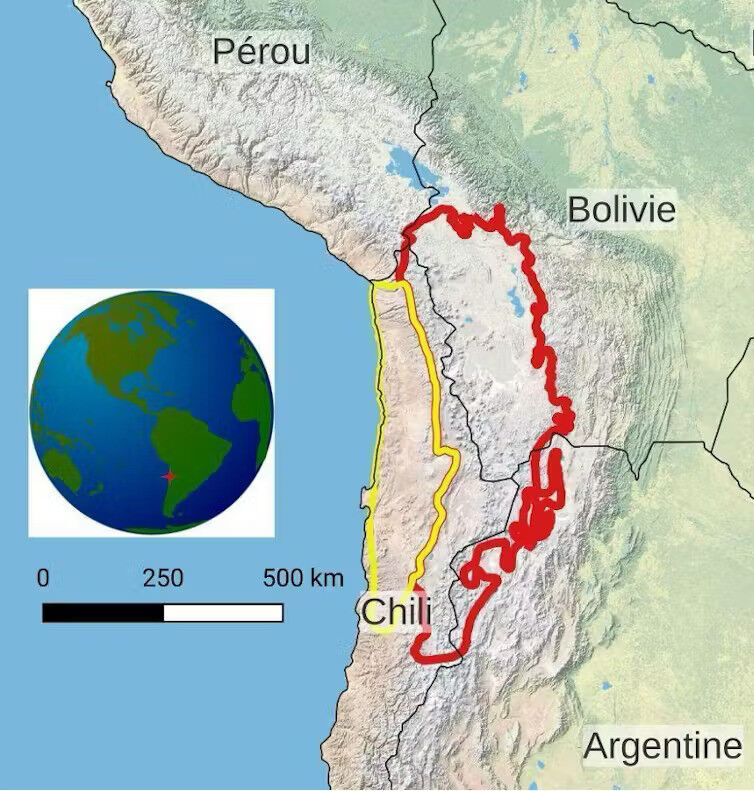
The Dry Puna and the Atacama Desert straddle four countries (Argentina, Bolivia, Chile and Peru). The main characteristic of these particular geographical zones is their extreme aridity, which shapes landscapes that many would spontaneously describe as "lunar" or "Martian". Indeed, these two regions correspond to what are known in scientific jargon as planetary analogues: geographical locations present on Earth but which may resemble extraterrestrial environments.
The Dry Puna and the Atacama Desert are considered to be good terrestrial analogues of Mars, and could present physico-chemical conditions close to what the Red Planet might have experienced in the course of its geological history. They are therefore formidable natural laboratories for the fields of planetary science and astrobiology. Their rarity also attracts the interest of scientists the world over.
How do you go from a vague impression to a certainty of the preponderance of foreign work in the geographical area concerned-our Franco-Chilean team of geologists, geophysicists, astrophysicists and biologists has set up a systematic method for comparing articles based, in one way or another, on the exceptional characteristics of the Dry Puna and the Atacama Desert, in the fields of planetary science and astrobiology.
The results of this study were published in Meteoritics and Planetary Science, and our impression was confirmed: more than 60% of articles were published without involving a researcher belonging to a national institution in one of the countries hosting the Dry Puna and/or the Atacama Desert (5,369 articles analyzed from the general selection in Earth sciences, 161 for planetary sciences and astrobiology). The imbalance highlighted is similar to that in other scientific disciplines and is not limited to this region.
The scientific valorization of the natural heritage of certain countries, without any major contribution from local researchers, is giving rise to growing concern in part of the scientific community. In the course of this work, we have come across the relatively recent terms (since the 2000s) of helicopter science, parachute science, safari science or neo-colonial science (the preferred term in the remainder of this article), which put names to these practices characterized by the implementation of scientific research projects carried out by teams from developed countries (Global North) in developing or underdeveloped countries (Global South) without any involvement of local researchers.
These practices tend to be considered unethical, and the subject becomes a topic of discussion and publication within the hard sciences: most often in the form of a general diagnosis, but also in terms of quantification.
A number of scientific journals, pioneered by Geoderma (the benchmark in soil science) from 2020 onwards, have taken the initiative in taking an unequivocal stance against neo-colonial science practices, paving the way for changes in editorial lines to take account of the need to involve local researchers in scientific publications.
This is the case, for example, of all PLOS journals, which since 2021 have required the completion of a questionnaire for the inclusion of local researchers for research carried out in a third country, a requirement that has since been emulated by the scientific publishing world.
Ethical requirements for research carried out in foreign countries are thus becoming an important, but not yet major, editorial standard. Other levers could, however, be activated, such as restrictive national or international legislative frameworks imposing the participation of local researchers in fieldwork carried out by foreign scientists.
In France, for example, the implementation of research programs in exceptional territories such as the Kerguelen Islands (a French sub-Antarctic territory in the Indian Ocean) or Adélie Land in Antarctica requires that the project be led by a scientist who is a permanent employee of a French public research organization. Models to avoid the problem of cultural appropriation of a natural scientific heritage by researchers belonging to foreign institutions already exist, and constitute resources on which to build in order to limit these neo-colonial scientific practices. However, we feel that the scientific community needs to take a closer look at these practices.
The aim of our study, and of similar projects that have been gaining ground in recent years, is to make these neo-colonial scientific practices visible, in particular by quantifying the phenomenon, so that the issue can be debated within the community. In particular, this has enabled our team to ask fundamental questions about its scientific practices, and to (re)discover the significant contributions made over the last 60 years by sociologists and epistemologists on the deep historical roots that can link colonialism, imperialism and science, and more generally the relations between center and periphery (for example, the imbalances, within a single country, between metropolitan or central institutions and regional institutions).
The example of the terrestrial analogues of the Dry Puna and the Atacama Desert illustrates the economic, scientific and technological gaps that are gradually opening up between the North and the global South. Planetary sciences and astrobiology have historically been linked to the technological development of ambitious and extremely costly space programs, whose main ambitions were often not scientific. The countries of the Global South were thus unable to take advantage of the conquest of space in the second half of the 20th century to develop a local scientific community in planetary sciences and astrobiology.
Efforts are currently underway on the South American continent to remedy this situation and facilitate the identification of local scientific contacts by researchers from foreign institutions wishing to carry out research in planetary sciences or astrobiology in South America. Virtuous steps have also been taken between certain South American researchers and their counterparts in the global North, to develop ex nihilo local research initiatives in specific fields of planetary science and astrobiology (for example, in relation to a case with which our team is very familiar, meteorite research in Chile).
In the field of astronomy, on the bangs of planetary sciences and astrobiology, the setting up of major international observatories on Chilean soil has enabled the structuring of a local community of astronomers and thus represents a good example of the beginning of fruitful cooperation between the global North and South. Let’s not forget to mention the remarkable and exemplary development of astrobiology in Mexico, in the footsteps of Mexican scientists Antonio Lazcano and Rafael Navarro-González, which demonstrates that independent local structuring is still possible and can generate a positive dynamic for the entire South American continent.
However, all these initiatives are still too rare or too unbalanced in favor of leadership from the global North, and cannot, in our view, replace a thorough introspection of scientific research practices. At a time when the legitimacy of science is being challenged, we believe that such a self-critical effort on the part of the scientific community would not be superfluous.
Adrien Tavernier , Scientist in environmental sciences, Universidad de Atacama and Gabriel A. Pinto , Postdoctoral Researcher, Université Libre de Bruxelles (ULB) This article is republished from The Conversation under Creative Commons licence. Read the original article.