An international research team led by Gino Caspari from the University of Bern has analyzed tattoos on a Siberian ice mummy that is over 2000 years old. For the study, the team used high-resolution near-infrared photography and collaborated with a contemporary tattoo artist. The results suggest that tattooing was a similar craft in prehistoric Siberian society as it is today.
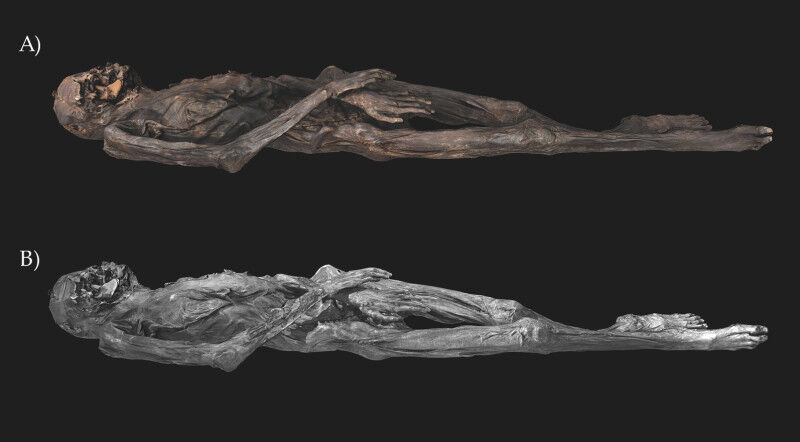
For the first time, an international research team has examined tattoos on an ice mummy more than 2000 years old using high-resolution digital imaging. The mummy comes from the Siberian Pazyryk culture and was buried in the permafrost of the Altai region, which enabled the extraordinary preservation of the tattooed skin.
First high-resolution three-dimensional image of an ice mummy

The tattoos of ice mummies of the Pazyryk culture are of crucial importance for the archaeology of Siberia, as they provide a deeper understanding of the culture and life of the people in this region during the Iron Age. Until now, however, there have been few detailed studies of the tattoos, as high-resolution image data was lacking for a long time. An international research team led by Dr. Gino Caspari from the University of Bern and the Max Planck Institute in Germany has now examined the tattoos in unprecedented image sharpness. In this way, the researchers were also able to identify the artisanal background of the tattoos. The results
Tattoo craft similar to today

’The tattoos of the Pazyryk culture have long fascinated archaeologists with their elaborate, vivid depictions,’ says Gino Caspari, who conducts research at the Institute of Archaeological Sciences at the University of Bern and the Max Planck Institute for Geoanthropology in Jena (Germany). Previous studies have mainly relied on schematic drawings and concentrated on stylistic and symbolic aspects.
For a more comprehensive analysis of tattooed skin, the research team created a three-dimensional image of an ice mummy using digital infrared photography with submillimeter resolution. In collaboration with a contemporary tattoo artist, the researchers analyzed the tattoos in detail - and were able to identify specific tools and techniques used to create them. They discovered that a dotting technique with various tools was used.

The analyses showed that the tattoos on the right forearm were finer and more technically sophisticated than those on the left forearm. This indicates that different tattooists were involved or that the same person tattooed at different stages of their training.

These findings suggest that tattooing in Pazyryk culture was not just an aesthetic means of expression, but a specialized craft that required technical skill, aesthetic sensibility and formal training.
’The study opens up new perspectives on individual freedom of action in prehistoric body design,’ says Caspari. ’Through our study, tattooing emerges not only as symbolic decoration, but as a complex craft that is in no way inferior to modern tattoo art.’ Caspari adds: ’It felt like we could really meet the people behind the art for the first time - see how they worked, learned and also made mistakes. The paintings began to come alive.