A forest with a high diversity of tree species can buffer heat waves in summer and cold spells in winter better than a forest with fewer tree species. This is the result of a study led by the German Center for Integrative Biodiversity Research (iDiv), Leipzig University and Martin Luther University Halle-Wittenberg (MLU). The study was conducted in a large field experiment with planted trees in China and published in the journal Ecology Letters. It provides a further argument for the diversification of tree species, especially in the face of advancing climate change.
Temperatures are rising in many places around the world due to the man-made increase in greenhouse gases. These climatic shifts also include changes in temperature extremes: while the number of cold waves in winter is decreasing (i.e. they are getting warmer), heat waves are increasing. It has long been known that trees buffer temperature extremes in forests, reducing heat waves in summer and cold waves in winter. Until now, it was not clear what role the number of tree species plays in this: Can more tree species buffer heatwaves and cold spells better? "Previous research has shown that the buffered temperatures below the tree canopy are important for biodiversity in forests, as they slow down the shift towards species that prefer warm temperatures caused by climate change," says co-first author Dr. Florian Schnabel from the University of Freiburg, who led the research during his time at iDiv and the University of Leipzig and then continued it in Freiburg. "At the same time, the effect of tree species diversity, a central facet of forest biodiversity, on temperature buffering in the forest is still largely unexplored."
THE WORLD’S LARGEST FIELD EXPERIMENT
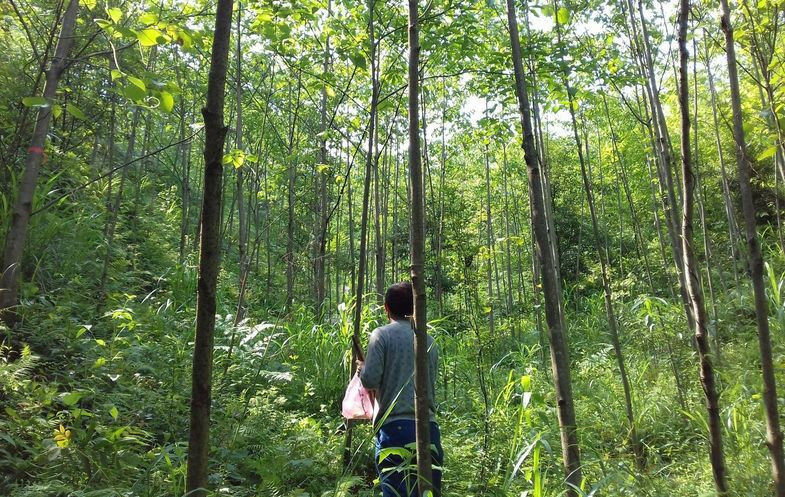
To answer this question, the researchers used the world’s largest planted field experiment on tree diversity in subtropical China. In the so-called BEF China experiment, several hundred thousand trees were planted in plots consisting of 1, 2, 4, 8, 16 or 24 different tree species. Since the founding of iDiv, the BEF-China experiment has been one of iDiv’s most important research platforms; it has led to a German-Chinese group of international junior researchers who are conducting temperature measurements in
TREE SPECIES DIVERSITY BUFFERS TEMPERATURE EXTREMES
The results showed that forests rich in tree species lower the temperatures under the canopy during heat waves more than forests with fewer tree species. The effect was strongest during the midday heat in summer. On test plots with 24 tree species, the cooling was up to 4.4 degrees Celsius greater than on plots with only one tree species.
At the same time, species-rich forests increased temperatures during cold winter nights more than species-poor forests. However, the researchers found no difference in the monthly average temperature between forests of different diversity.
TREE CROWN DENSITY AND STRUCTURAL DIVERSITY EXPLAIN THE DIVERSITY EFFECT
The researchers also found a possible explanation for how species diversity affects temperature buffering. Experimental plots with many tree species had both higher tree canopy density (more leaf area per ground area) and higher structural diversity (e.g. a greater variety of smaller and larger trees). These factors improved temperature buffering, possibly due to less mixing of air masses.
"Temperature buffering effects are good for people looking to cool down during a heatwave, but they also have an impact on the ecosystem itself," says co-first author Dr. Rémy Beugnon from iDiv, Leipzig University and the Centre d’Ecologie Fonctionnelle et Evolutive. "A buffered climate creates more favorable conditions for ecosystems and protects the services they provide. Forests can grow and regenerate better in a buffered microclimate. Soils also function better, promote greater biodiversity, improve nutrient cycles and increase carbon storage."
Good reasons for more biodiversity

The new study provides a further argument as to why more biodiversity in trees can be good for people and nature. "Although typical tree monocultures, such as those planted worldwide, are important for timber production, they not only have less biodiversity than natural or diverse planted forests, but also provide fewer services other than timber production," says the senior author, "Our study has clearly shown that this temperature buffering effect of tree species-rich forests has the potential to mitigate the negative effects of global warming and climate extremes on the entire forest ecosystem."
Original title of the publication in Ecological Letters::
Tree diversity increases forest temperature buffering via enhancing canopy density and structural diversity. DOI: 10.1111/ele.70096