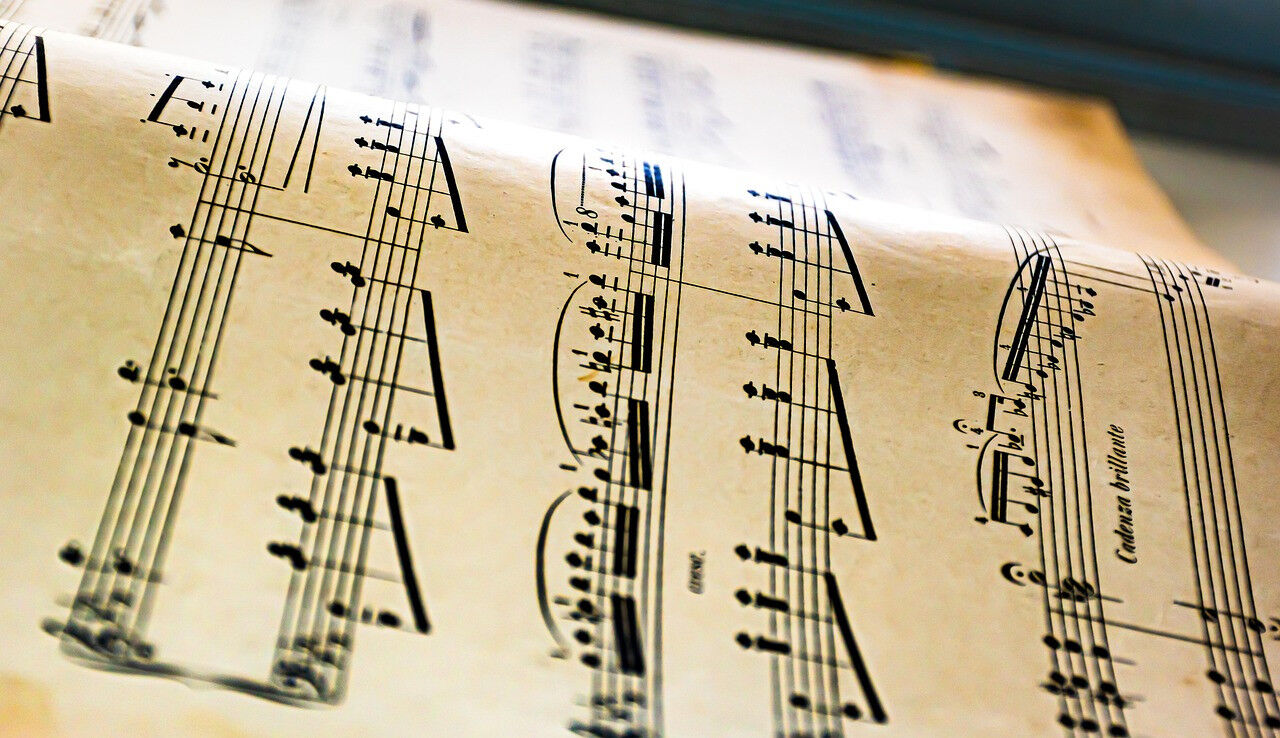
The musical notation used today stabilized in the 19th century, at the time of the massive development of printed music publishing. Since its birth in the 9th century, Western music notation has always evolved with the repertoire being performed, and its current conventions derive from innovations introduced in the early Baroque period. Since then, musical practices have undergone profound changes: contemporary musicians perform extremely varied repertoires, from Bach to Stravinsky, without always having the stylistic keys that the performers of yesteryear possessed.
"The conventions of musical notation used today were established in the 19th century and undoubtedly influence the way musicians interpret works," explains Romain Felis, PhD student at the ULB Musicology Laboratory and conductor of the ULB Symphony Orchestra. "For example, the addition of barlines in modern editions of early music alters the perception of phrasing and musical breathing."
This relative rigidity of the graphic system is prompting many musicians - regardless of musical style - to question the limits of written musical language and the possibility of rethinking it.
Rethinking page layout rather than inventing a new language
Against this backdrop, Cambridge University researcher Arild Stenberg Stenberg has developed a new approach. Rather than creating new musical symbols, he proposes to rethink the visual structure and layout of scores to improve their legibility and expressiveness, in the same way as one would optimize the typography of a text.
"The research aims to design a new, more legible and expressive notation, without inventing a new symbolic language, but by rethinking the layout and visual structure of the score", explains Arild Stenberg.
A first experience on an orchestral scale
"This is the first time such a study has been carried out on the scale of a full orchestra," stresses Arild Stenberg. "The collaboration with Romain Felis and the Orchestre de l’Université libre de Bruxelles enables us to study the legibility and expressiveness of this notation in a collective setting."
Until now, experiments have been carried out with individual musicians. The ULB Orchestra now makes it possible to evaluate the impact of this notation on collective interpretation and audience perception.
To guarantee the scientific rigor of the experiment, the researchers chose to work on two little-known waltzes by Belgian composer Charles-Louis Hanssens (1793-1871), a major figure in 19th-century Brussels musical life whose manuscripts are held in the collections of the Bibliothèque du Conservatoire Royal de Bruxelles. This choice eliminates the bias associated with familiarity with famous works: the two waltzes, of similar difficulty, will enable comparisons to be made between traditional and new notation.
A concert-experience for musicians and audiences
The public will attend two concerts in November 2025, on the 16th at the Palais des Beaux-Arts in Charleroi and on the 19th in Brussels, in the ULB’s Janson auditorium. Questionnaires will be distributed to spectators after the performances to gather their impressions.
As for the musicians of the ULB Orchestra, they will have been familiarized with the new notation during work sessions, which will enable us to assess the real impact of this new writing on interpretation after appropriation.
The musical program will place Hanssens’ waltzes in their historical context, with Beethoven’s 5th Symphony and an excerpt from Berlioz’s Symphonie fantastique, recreating the atmosphere of 19th-century Brussels concerts.
"The chosen works are technically sound, enjoyable and humorous," say Arild Stenberg and Romain Felis jointly. "They will offer audiences a lively rediscovery of a forgotten Belgian composer."
Two St-V concerts: Brussels and Charleroi
The ULB Symphony Orchestra’s organization of two Saint-Verhaegen concerts meets several objectives. On a scientific level, it enriches the data collected from different audiences. On an institutional level, it is in line with ULB Culture’s desire to strengthen links between the University’s different sites, particularly with the new Charleroi campus.
This collaboration with the Palais des Beaux-Arts de Charleroi illustrates ULB’s commitment to developing its cultural and scientific activities beyond the capital.
The project is supported by the Wiener Anspach Foundation, which funds interdisciplinary collaborations between Cambridge and ULB. Cambridge contributes the theoretical conception of this new notation, while ULB offers a unique testing ground with its university orchestra.
Info and booking
Palais des Beaux-Arts de Charleroi and in Brussels, in ULB’s Janson auditorium