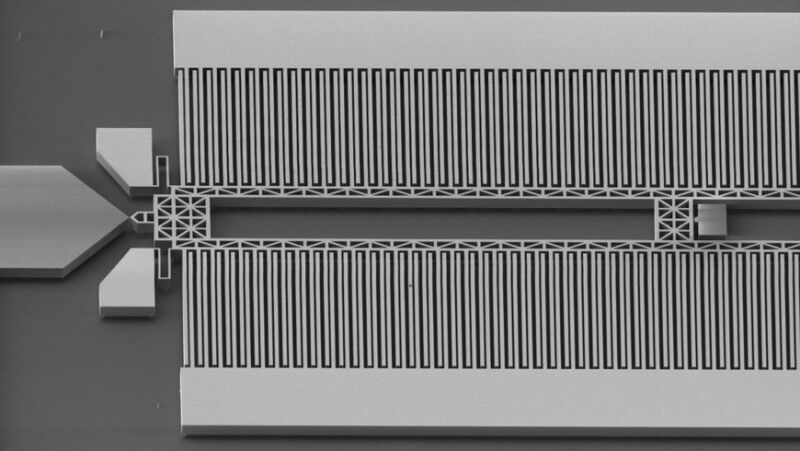
The silicon comb moves for 200 nanometers before getting pushed back into its original position by the built-in spring. This movement cannot be seen with the naked eye nor with an optical microscope, so Peter Lendway, doctoral candidate at Empa’s Transport at Nanoscale Interfaces laboratory and at ETH Zurich, used a scanning electron microscope to record it. For the resulting video, the researcher was awarded first prize in the video category of the SNSF scientific image competition.
The system in the video is one of several systems Lendway has developed for different types of nanomaterials. All systems use an electrostatic actuator in which capacitors are arranged in several rows like the teeth of a comb. Two of these comb-like structures interlock without touching each other. Voltage is applied to one of the combs - visible in the video as a dark discoloration. This causes the charged and uncharged combs to attract each other. A stopper at one end of the actuator ensures that the movement does not exceed 200 nanometers. As soon as the voltage is reduced, a springs return the actuator to its starting position. The system in the video is designed to contact individual molecules. For this purpose, there is a fine bridge of pure gold at the left end of the structure that can be broken to form atomically sharp electrodes.
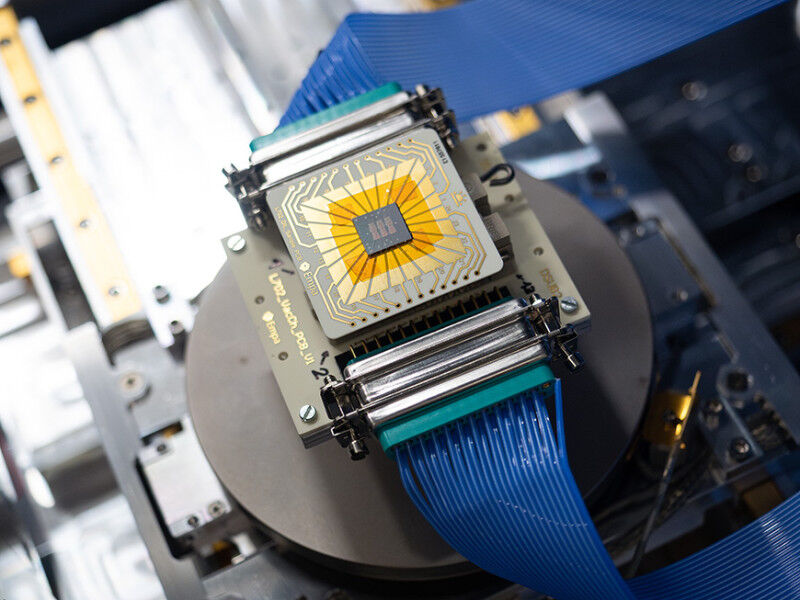
"Calculations and simulations in theoretical physics show that, under mechanical stress, these carbon-based nanomaterials could acquire novel electronic, optical and mechanical properties," explains Lendway. "However, so far hardly anyone has succeeded in demonstrating these effects experimentally - especially under cryogenic conditions. Measurements at very low temperatures are an essential prerequisite for most applications in quantum technology." Deforming quantum materials just a few nanometres in size in a controlled manner without damaging them, and measuring their properties at the same time is no easy task. As part of his doctorate at the Department of Information Technology and Electrical Engineering (D-ITET) of ETH Zurich, Lendway is developing a platform that will make this possible. His work is supported by the Swiss National Science Foundation (SNSF) and the State Secretariat for Education, Research and Innovation .
Lendway’s project is not yet complete. "We have successfully developed various platforms, each of which is suitable for a different nanomaterial. Now we are starting to investigate their properties," says the researcher. Their findings could one day contribute to the development of nanoscale electronic components with new characteristics, which would open up possibilities in the fields of quantum technologies and more efficient energy use and help us better understand materials at a fundamental level.