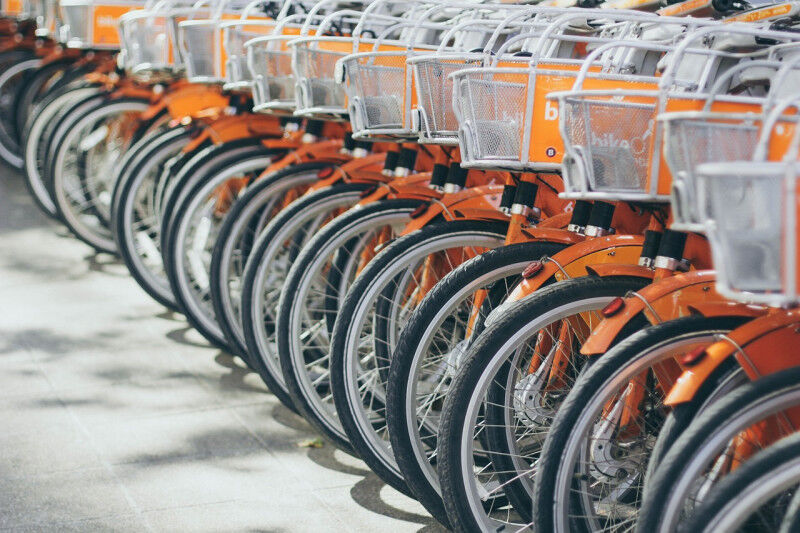
Mobility concepts can reduce car traffic and promote the switch to sustainable modes of transport - if they are well planned, implemented and monitored. This is particularly true for cities, as a new study shows.
In urban areas in particular, demand for mobility will rise sharply as a result of population growth - with a corresponding impact on roads and public transport. This makes it all the more important to coordinate settlement development with the resulting traffic and municipal requirements such as parking regulations. Mobility concepts have become an important planning tool in the development of residential areas: they can combine measures such as car waivers, reduced parking spaces, car sharing, bike rental systems or mobility vouchers to promote more environmentally friendly mobility in residential areas and reduce the burden on the transport infrastructure. The Lucerne University of Applied Sciences and Arts (HSLU), EBP Schweiz AG (project management), Trafiko AG and bernhard uvb have systematically investigated how effective such concepts actually are in Switzerland. The study, financed by the Federal Roads Office (FEDRO), provides the first well-founded empirical findings on this subject.
Great effect in urban areas
The study examined 19 settlements in cities and agglomerations with and without a mobility concept. A clear effect can be seen in urban areas: where mobility concepts with effective measures have been implemented, the proportion of motorized private transport in overall mobility is significantly lower, car ownership is lower and the use of sharing services is higher. Examples include the ’Matteo Mattenhof’ development in Kriens (LU) and the Burgunder housing estate in Bern-Bümpliz. So-called ’push’ measures - such as a reduced parking space ratio - have a much greater impact than voluntary ’pull’ offers such as sharing models or mobility vouchers.
In less dense areas, however, no significant differences in mobility behavior are discernible - regardless of whether a mobility concept is in place. HSLU researcher and co-author of the study Michael Stiebe classifies: ’Less dense public transport connections, greater distances and a generally higher car dependency lead to mobility concepts outside urban areas being implemented not to avoid cars, but to increase the quality of life.’
Consistent implementation and communication are crucial
The study shows that the decisive factor is not the mere existence of a concept, but its consistent implementation. ’However, many concepts have so far remained vague and without clear impact monitoring,’ says Stiebe. The researchers therefore recommend a standardized monitoring procedure and the early integration of mobility planning in all phases of project development. The role of the public sector is also key: Only with binding specifications on content and quality can mobility concepts develop their full potential.
Self-selection shapes impact in cities
Stiebe is not surprised that mobility concepts are implemented more consistently in urban areas: ’Many people are willing to adapt their mobility behavior to new conditions - also because they appreciate the location and offers. The housing shortage further increases this willingness.
However, the study also shows that an above-average number of people with already sustainable mobility behavior settle in such areas. For car owners, the lack of a parking space is often a criterion for excluding an apartment. The result: it is not the behavior that changes, but the residents - an effect that the study describes as self-selection and which is already known and well documented from a number of previous studies. Nevertheless, mobility concepts do not fail to have an effect: ’In urban areas, there are many people who fit in well with such concepts,’ says Stiebe.
However, the researcher would not speak of a displacement of people with a more frequent use of private cars from the city center: ’Areas with a mobility concept make up a small part of the housing market. The majority of the population will continue to live in apartments without such requirements,’ Stiebe continues. In addition, mobility concepts can be restrictive in different ways and do not categorically exclude parking spaces. ’Those who are dependent on a car for work, for example, can also benefit from good public transport connections and cycle path infrastructure in their leisure time,’ says the co-author of the study.