Researchers from TU/e and ETH Zurich have found the holy grail of brewing: the formula for stable beer foam, and it’s down to protein structure.
The researchers have studied the foam of six commercial beers: two triple-fermented Belgian beers, two Swiss lagers, one single-fermented Belgian beer, and one double-fermented Belgian beer. They discovered that the foam of triple-fermented beers last longest, while the foam of single-fermented beers are the least stable. And it all comes down to the structure of proteins that lie on the surface of the bubbles.
Source: ETH Zurich
Summertime is beer time in many countries - even if the consumption of alcoholic beers is declining in the Netherlands, Switzerland, and other countries across Europe.
For many beer lovers there is nothing better than a head of foam topping a glass of golden, sparkling barley juice. However, with many beers, the dream quickly shatters when the foam collapses before that first sip. There are also types of beer, however, where the head lasts a long time.
Beer foam is made of tiny bubbles of air separated by thin films of liquid, not unlike soap bubbles. When the bubbles pop, the foam collapses, and in the case of beer this can negatively affect taste.
Foam watching
researchers from Eindhoven University of Technology Manolis Chatzigiannakis en Alexandra Alicke (both from the Department of Mechanical Engineering) in collaboration with researchers at ETH Zurich have now discovered just why the foam collapses. The work started seven years ago while both Chatzigiannakis and Alicke were PhD students in the group of Jan Vermant at ETH Zurich.

"It started as a fun side-project of my PhD", recalls Chatzigiannakis, "Alexandra, who was at that time a PhD with more experience than me, helped out with some additional measurements and interesting discussions."
The research study was initiated and led by Jan Vermant, Professor of Soft Materials at ETH Zurich, and it has just been published in the journal Physics of Fluids. It all started out with a simple question put to a Belgian brewer (Vermant hails from Belgium): How do you control fermentation? "By watching the foam," was the brief reply from the brewer in question.
Thanks to this research study, the scientists understand the mechanisms at work behind perfect beer foam. Thanks to this work, perhaps future beer drinkers will be able to admire the head of foam in their glasses a little longer before quenching their thirst. For the brewers themselves, knowing more about the exact mechanisms might help them improve their brewing process.
Lager beers have the most fleeting foam
In this study, the material scientists showed that Belgian beers that have been triple fermented have the most stable foam, followed by double fermented beers. The head is least stable in single fermented lager beers.
Triple-fermented beers include Trappist beers, a speciality of the eponymous monastic order. A beer from a large Swiss brewery was also among the lager beers the researchers examined. "There is still room for improvement. We are happy to help," says Vermant with a smile.
To date, researchers assumed that the stability of beer foam depended primarily on protein-rich layers on the surface of the bubbles : proteins come from barley malt and influence surface viscosity, i.e. the stickiness of the surface, and the surface tension.
Surface stress instead of viscosity

The new experiments, however, show that the decisive mechanism is more complex and depends significantly on the type of beer.
"Our goal was to study what happens in the thin film that separates two neighbouring bubbles in the beer foam," says TU/e researcher Chatzigiannakis, who is also the lead author for the new scientific paper.
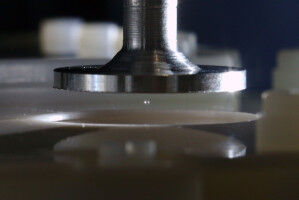
To study how the bubbles interact with each other, the team used a variety of imaging and rheometry methods. "We were able to visualize what’s happening when two bubbles come into close proximity," said Chatzigiannakis. "And we can directly resolve the bubble’s protein aggregates, their interface, and their structure."
In single-fermentation lager beers, surface viscosity is the decisive factor. This is influenced by the proteins present in the beer: the more proteins the beer contains, the more viscous the film around the bubbles becomes and the more stable the foam will be.
The situation is different with multi-fermentation Trappist beers, where surface viscosity is actually minimal. Stability is achieved through so-called Marangoni stresses - forces that arise from differences in surface tension.
This effect can be readily observed by placing crushed tea leaves on the surface of water. Initially, the fragments spread out evenly. If a drop of soap is added, the tea leaves are suddenly pulled to the edge, causing currents to circulate on the surface. If these currents persist for a long time, they stabilise the bubbles in the beer foam.
Protein decisive for foam quality
The protein LTP1 (lipid transfer protein 1) plays a decisive role in stabilising beer foam. The research team from TU/e and ETH Zurich were able to confirm this by analysing the protein content of the beers they studied.

In single fermentation beers, such as lager beers, the so-called LPT1 proteins are present in their original form. They act like small, spherical particles that arrange themselves densely on the surface of the bubbles. This corresponds to a two-dimensional suspension, i.e. a mixture of a liquid and finely distributed solids, which in turn stabilises these bubbles.
During the second fermentation, the proteins are slightly denatured by the yeast cells, meaning that their natural structure is slightly altered. They then form a net-like structure, a kind of membrane, making the bubbles even more stable.
During the third fermentation, the already altered LPT1 proteins are denatured to such an extent that fragments with a water-repellent and a ’water-loving’ end are formed.
These fragments reduce the interfacial and surface tensions and stabilise the bubbles to the maximum possible extent. "These protein fragments function like surfactants, which stabilise foams in many everyday applications such as detergents," explains Vermant.
Collaboration with a major brewery
As Vermant emphasises: "The stability of the foam does not depend on individual factors in a linear manner. You can’t just change ’something’ and get it ’right’."
For example, increasing the viscosity with additional surfactants can actually make the foam more unstable because it slows down the Marangoni effects too strongly. Vermant: "The key is to work on one mechanism at a time - and not on several at once. Beer obviously does this well by nature!"

Over the course of this study, the team collaborated with one of the world’s largest breweries that was working on the foam stability of their beers and wanted to understand what stabilises beer foam. "We now know the mechanism exactly and are able to help the brewery improve the foam of their beers," says Vermant.
Applications beyond beer
The findings from this beer foam research are also significant for society beyond beer brewing.
In electric vehicles, lubricants can foam, and that presents a dangerous problem as foam reduces the ability of lubricants to remove heat from bearings, gears, and batteries. The researchers are now working with major lubricant companies to investigate how such foams can be destroyed in a targeted manner.
Another goal is to develop sustainable surfactants that are free of fluorine or silicon. In addition, the researchers are also working on foams as carriers for bacterial systems as part an ongoing project. Finally, the insights on beer foam could have implications for stabilising milk foam using proteins.
For Belgian beer consumers though, as well as those in the Netherlands, the foam head is important because it can influence the taste. However, foam isn’t that important everywhere beer is served, and it can depend on a country’s cultural relationship with beer.
Article title
The hidden subtlety of beer foam stability: A blueprint for advanced foam formulations
Physics of Fluids
Emmanouil Chatzigiannakis, Alexandra Alicke, Léa Le Bars Lucas Bidoire & Jan Vermant