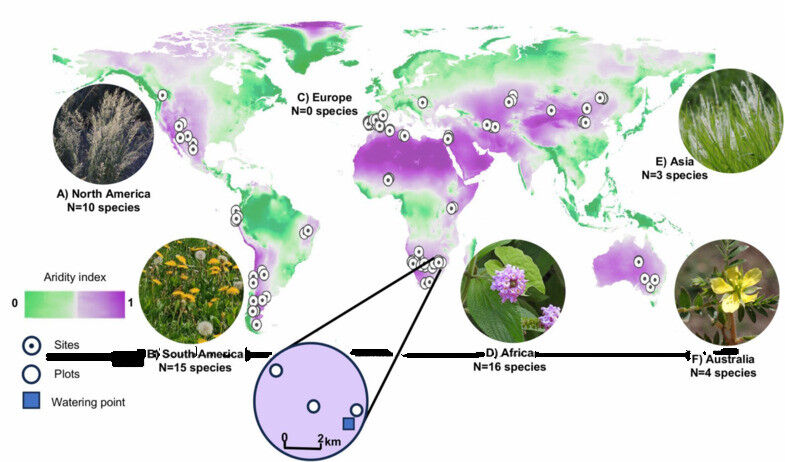
In a global study, researchers have discovered the conditions under which non-native plants thrive particularly well in the world’s many arid regions and what inhibits their spread. Using data from 98 study areas in 25 countries on six continents, they showed that these plants usually grow faster than native species and are particularly successful where soils are heavily grazed and richer in nutrients. In contrast, they spread less when many different native plants were present.
According to the scientists, the success of non-native perennial plants in arid regions depends on many different factors. These include the local climate, soil quality and the diversity of native plants. "A high level of biodiversity protects drylands from invasive plants," says Soroor Rahmanian from Leipzig University and the German Center for Integrative Biodiversity Research (iDiv). Together with Nico Eisenhauer, she is the first author of the study, which has just been published in the journal"Nature Ecology & Evolution".
Between 2016 and 2019, the researchers analyzed how environmental conditions, the interactions between plants and animals and human activities interact and influence the drylands. They focused on perennial plants and examined 41 non-native species. Most of these plants only occurred in small quantities. Only a few were particularly common in certain areas.
Around 45 percent of the Earth’s surface consists of drylands. They provide a habitat for over two billion people. despite their importance to the environment and society, little is known about how various factors influence the success of non-native perennial plant species in these areas. This depends heavily on the local conditions," emphasizes Eisenhauer from the University of Leipzig and iDiv.
"Non-native plants have spread mainly on heavily grazed areas with nutrient-rich soil. These conditions are often found in less extremely dry areas and favor plants that grow quickly and can cope well with disturbances," says Rahmanian. In addition to higher soil fertility, faster decomposition rates and a greater abundance of fungi would have favored the growth of non-native plants.
The researchers also found that non-native plants are often larger and therefore absorb more nutrients from the soil. These characteristics help them to make better use of the nutrient-rich and adverse conditions created by grazing.
Original title of the publication in "Nature Ecology & Evolution":
"Abiotic and biotic controls of non-native perennial plant success in drylands", DOI: 10.1038/s41559-025-02971-6