

Campus - GLASGOW - Today
Evidence from five decades of graduates confirms Humanities skills power careers and lifelong impact
Evidence from five decades of graduates confirms Humanities skills power careers and lifelong impact
Pharmacology - Today
Detail-oriented and data-driven: Pharmaceutical Sciences graduate Elisabeth Schweiberer
Detail-oriented and data-driven: Pharmaceutical Sciences graduate Elisabeth Schweiberer
Life Sciences - Mar 13
New DNA tools outperform traditional methods for detecting genetic risk in wildlife
New DNA tools outperform traditional methods for detecting genetic risk in wildlife
Health - Mar 13
Oxford and Serum Institute of India sign IP license agreement to advance NipahB vaccine candidate
Oxford and Serum Institute of India sign IP license agreement to advance NipahB vaccine candidate
Life Sciences - Mar 13
How the brain creates meaning: Martin Vinck investigates the key to thoughts, attention and consciousness
How the brain creates meaning: Martin Vinck investigates the key to thoughts, attention and consciousness





Career - Mar 12
Women often need stronger professional networks to climb corporate ladder, Western analysis shows
Women often need stronger professional networks to climb corporate ladder, Western analysis shows
Environment - Mar 12
Turning dairy emissions into opportunities: how climate finance can drive climate-smart dairy
Turning dairy emissions into opportunities: how climate finance can drive climate-smart dairy

news
CERN - Conseil Européen de la Recherche Nucléaire
Results 21 - 33 of 33.
Physics - 03.06.2015
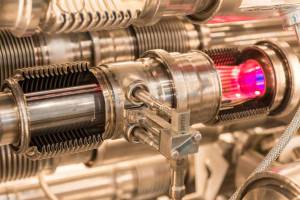
Today, CERN 's Large Hadron Collider (LHC) started delivering physics data for the first time in 27 months. After an almost two year shutdown and several months re-commissioning, the LHC is now providing collisions to all of its experiments at the unprecedented energy of 13 TeV, almost double the collision energy of its first run.
Physics - Chemistry - 11.02.2015
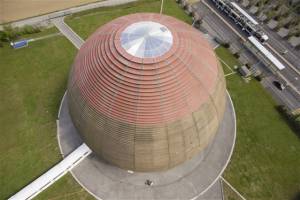
The COMPASS experiment at CERN reports a key measurement on the strong interaction. The strong interaction binds quarks into protons and neutrons, and protons and neutrons into the nuclei of all the elements from which matter is built. Inside those nuclei, particles called pions made up of a quark and an antiquark mediate the interaction.
Physics - 19.11.2014
Physics - Astronomy & Space - 18.09.2014

The Alpha Magnetic Spectrometer (AMS ) collaboration has today presented its latest results. These are based on the analysis of 41 billion particles detected with the space-based AMS detector aboard the International Space Station. The results, presented during a seminar at CERN 2 , provide new insights into the nature of the mysterious excess of positrons observed in the flux of cosmic rays.
Environment - Chemistry - 16.05.2014
Experiment sheds new light on cloud formation
CERN 's CLOUD experiment has shown that biogenic vapours emitted by trees and oxidised in the atmosphere have a significant impact on the formation of clouds, thus helping to cool the planet. These biogenic aerosols are what give forests seen from afar their characteristic blue haze. The CLOUD study shows that the oxidised biogenic vapours bind with sulphuric acid to form embryonic particles which can then grow to become the seeds on which cloud droplets can form.
Physics - 08.05.2013
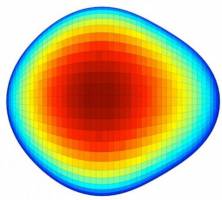
A team has shown that some atomic nuclei can assume asymmetric, "pear" shapes. The observations contradict some existing nuclear theories and will require others to be amended. Most nuclei have the shape of a rugby ball. While state-of-the-art theories are able to predict this behaviour, the same theories have predicted that for some particular combinations of protons and neutrons, nuclei can also assume asymmetric shapes, like a pear.
Physics - 24.04.2013
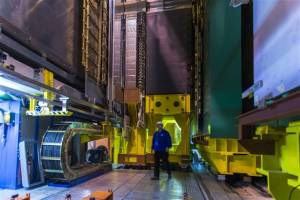
The LHCb collaboration at CERN observed the first matter-antimatter asymmetry in the decays of the particle known as the B0 s . It is only the fourth sub-atomic particle known to exhibit such behaviour. Matter and antimatter are thought to have existed in equal amounts at the beginning of the universe , but today the universe appears to be composed essentially of matter.
Physics - 04.07.2012
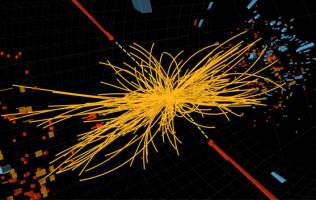
Geneva, 4 July 2012. At a seminar held at CERN today as a curtain raiser to the year's major particle physics conference, ICHEP2012 in Melbourne, the ATLAS and CMS experiments presented their latest preliminary results in the search for the long sought Higgs particle. Both experiments observe a new particle in the mass region around 125-126 GeV.
Physics - 31.10.2011
Successful LHC proton run
After some 180 days of running and four hundred trillion proton proton collisions, the LHC's 2011 proton run came to an end at 5.15pm yesterday evening. For the second year running, the LHC team has largely surpassed its operational objectives, steadily increasing the rate at which the LHC has delivered data to the experiments.
Environment - 25.08.2011
Unprecedented insight into cloud formation
The CLOUD experiment has been designed to study the effect of cosmic rays on the formation of atmospheric aerosols - tiny liquid or solid particles suspended in the atmosphere - under controlled laboratory conditions. Atmospheric aerosols are thought to be responsible for a large fraction of the seeds that form cloud droplets.
Physics - 06.12.2010
Antimatter: A step forward
The ASACUSA experiment at CERN has taken an important step forward in developing an innovative technique for studying antimatter. Using a novel particle trap, called a CUSP trap, the experiment has succeeded in producing significant numbers of antihydrogen atoms in flight. Antimatter - or the lack of it - remains one of the biggest mysteries of science.
Physics - 17.11.2010
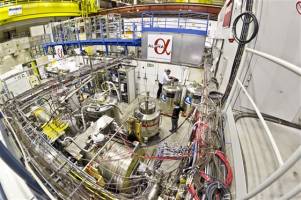
The ALPHA experiment at CERN has taken an important step forward in developing techniques to understand one of the Universe's open questions: is there a difference between matter and antimatter? A study shows that it has successfully produced and trapped atoms of antihydrogen. This development opens the path to new ways of making detailed measurements of antihydrogen, which will in turn allow scientists to compare matter and antimatter.
Physics - 04.11.2010
The LHC enters a new phase
Proton running for 2010 in the LHC at CERN came to a successful conclusion. Since the end of March 2010, when the first collisions occurred at a total energy of 7 TeV, the machine and experiment teams have achieved all of their objectives for the first year of proton physics at this record energy and new ground has been explored.


Campus - GLASGOW - Today
Evidence from five decades of graduates confirms Humanities skills power careers and lifelong impact
Evidence from five decades of graduates confirms Humanities skills power careers and lifelong impact
Pharmacology - Today
Detail-oriented and data-driven: Pharmaceutical Sciences graduate Elisabeth Schweiberer
Detail-oriented and data-driven: Pharmaceutical Sciences graduate Elisabeth Schweiberer
Life Sciences - Mar 13
New DNA tools outperform traditional methods for detecting genetic risk in wildlife
New DNA tools outperform traditional methods for detecting genetic risk in wildlife
Health - Mar 13
Oxford and Serum Institute of India sign IP license agreement to advance NipahB vaccine candidate
Oxford and Serum Institute of India sign IP license agreement to advance NipahB vaccine candidate
Life Sciences - Mar 13
How the brain creates meaning: Martin Vinck investigates the key to thoughts, attention and consciousness
How the brain creates meaning: Martin Vinck investigates the key to thoughts, attention and consciousness
Career - Mar 12
Women often need stronger professional networks to climb corporate ladder, Western analysis shows
Women often need stronger professional networks to climb corporate ladder, Western analysis shows
Environment - Mar 12
Turning dairy emissions into opportunities: how climate finance can drive climate-smart dairy
Turning dairy emissions into opportunities: how climate finance can drive climate-smart dairy