



Life Sciences - Today
Understanding the Brain - TU Ilmenau's EU EMBRACE Project Nominated for European Excellence Award
Understanding the Brain - TU Ilmenau's EU EMBRACE Project Nominated for European Excellence Award
Social Sciences - Today
A manual addresses, for the first time in Spain, child and adolescent sexual exploitation
A manual addresses, for the first time in Spain, child and adolescent sexual exploitation


Environment - Mar 26
Changing vegetation in thawing permafrost increases emissions of greenhouse gases
Changing vegetation in thawing permafrost increases emissions of greenhouse gases
Environment - Mar 26
University of Manchester hits major sustainability milestone, with Main Campus becoming 100% 'Zero Landfill'
University of Manchester hits major sustainability milestone, with Main Campus becoming 100% 'Zero Landfill'
Social Sciences - Mar 26
"It would be naive to believe that a social media ban will solve all problems"
"It would be naive to believe that a social media ban will solve all problems"


Health - Mar 26
Earlier detection, better outcomes: Irish researchers target rising bowel cancer rates with new blood test
Earlier detection, better outcomes: Irish researchers target rising bowel cancer rates with new blood test

Environment - Mar 26
UK must improve energy efficiency to end 50 years of policy failure and prevent future energy crises, study argues
UK must improve energy efficiency to end 50 years of policy failure and prevent future energy crises, study argues
Mathematics - Mar 26
From Materials to Medical Imaging, Fonseca's Work Shapes the Future of Innovation
From Materials to Medical Imaging, Fonseca's Work Shapes the Future of Innovation


news
Chemistry
Results 2921 - 2940 of 3958.
Physics - Chemistry - 09.07.2015
Researchers develop artificial, bonelike material for use with medical devices
Researchers have developed a new approach for better integrating medical devices with biological systems. The researchers, led by Bozhi Tian, assistant professor in chemistry at the University of Chicago, have developed the first skeleton-like silicon spicules ever prepared via chemical processes. "Using bone formation as a guide, the Tian group has developed a synthetic material from silicon that shows potential for improving interaction between soft tissue and hard materials," said Joe Akkara, a program director in "This is the power of basic scientific research.
Physics - Chemistry - 08.07.2015

Berkeley Lab researchers' novel diffraction spectroscopy technique will provide insight to chemical processes at important battery interface. One of the most important things to understand in battery technology is the precise physical and chemical processes that occur at the electrode/electrolyte interface.
Life Sciences - Chemistry - 03.07.2015
"Invisible" protein structure explains the power of enzymes
A research group at Umeå University has managed to capture and describe a protein structure that, until now, has been impossible to study. The discovery lays the base for developing designed enzymes as catalysts to new chemical reactions for instance in biotechnological applications. The result of the study is published .
Physics - Chemistry - 02.07.2015
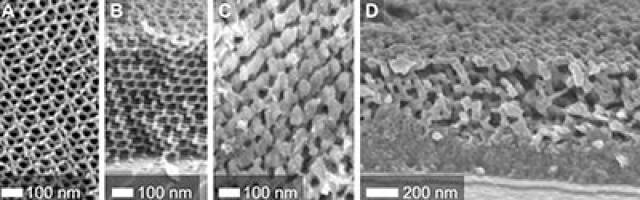
Using molds to shape things is as old as humanity. In the Bronze Age, the copper-tin alloy was melted and cast into weapons in ceramic molds. Today, injection and extrusion molding shape hot liquids into everything from car parts to toys. For this to work, the mold needs to be stable while the hot liquid material hardens into shape.
Physics - Chemistry - 01.07.2015
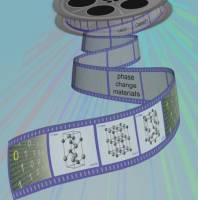
DVDs and Blu-ray disks contain so-called phase-change materials that morph from one atomic state to another after being struck with pulses of laser light, with data "recorded" in those two atomic states. Using ultrafast laser pulses that speed up the data recording process, Caltech researchers adopted a novel technique, ultrafast electron crystallography (UEC), to visualize directly in four dimensions the changing atomic configurations of the materials undergoing the phase changes.
Life Sciences - Chemistry - 01.07.2015
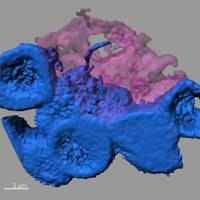
ANN ARBOR-When it comes to communicating with each other, some cells may be more "old school" than was previously thought. Certain types of stem cells use microscopic, threadlike nanotubes to communicate with neighboring cells, like a landline phone connection, rather than sending a broadcast signal, researchers at University of Michigan Life Sciences Institute and University of Texas Southwestern Medical Center have discovered.
Physics - Chemistry - 01.07.2015

Instruments that measure the properties of light, known as spectrometers, are widely used in physical, chemical, and biological research. These devices are usually too large to be portable, but MIT scientists have now shown they can create spectrometers small enough to fit inside a smartphone camera, using tiny semiconductor nanoparticles called quantum dots.
Chemistry - Physics - 30.06.2015
Chemists Characterize 3-D Macroporous Hydrogels
Carnegie Mellon University chemists have developed two novel methods to characterize 3-dimensional macroporous hydrogels - materials that hold great promise for developing "smart” responsive materials that can be used for catalysts, chemical detectors, tissue engineering scaffolds and absorbents for carbon capture.
Life Sciences - Chemistry - 26.06.2015
3-D scans of mating fruit flies uncovers female biology
Micro-CT scans revealed that the fruit-fly oviduct has a tight loop (see arrow) at its connection to the ovary. Contraction and then relaxation of this loop occur after mating, to control the timing of the movement of eggs out of the ovary. Following in the footsteps of Leonardo Da Vinci's 1493 anatomical sketch of a man and woman, "The Copulation," Cornell researchers used cutting-edge X-ray technology to noninvasively image fruit flies during and after mating.
Life Sciences - Chemistry - 26.06.2015
3-D scans of mating fruit flies uncover female biology
Micro-CT scans revealed that the fruit-fly oviduct has a tight loop (see arrow) at its connection to the ovary. Contraction and then relaxation of this loop occur after mating, to control the timing of the movement of eggs out of the ovary. Following in the footsteps of Leonardo Da Vinci's 1493 anatomical sketch of a man and woman, "The Copulation," Cornell researchers used cutting-edge X-ray technology to noninvasively image fruit flies during and after mating.
Health - Chemistry - 25.06.2015
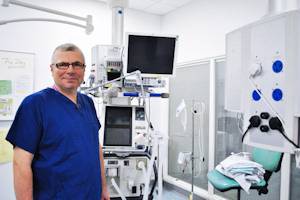
Researchers from The University of Manchester are part of a team that has identified an important new approach to diagnose infections in critically ill patients rapidly and accurately. A study by colleagues in Salford and Manchester found that chemically analysing breath specimens from patients in intensive care can reveal bacterial infection in the lower respiratory tract of ventilated patients at risk of developing pneumonia.
Life Sciences - Chemistry - 24.06.2015
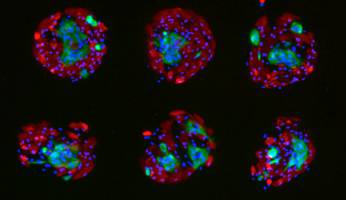
The vast majority of the thousands of chemicals in our homes and workplaces have not been tested to determine if they cause cancer. That's because today's options are lacking. Rodent tests are too slow, and cell culture tests don't replicate how cells interact in the body, so their relevance to cancer is limited.
Chemistry - Physics - 23.06.2015
SLAC’s new ‘molecular movie’ reveals ultrafast chemistry in motion
Scientists for the first time tracked ultrafast structural changes, captured in quadrillionths-of-a-second steps, as ring-shaped gas molecules burst open and unraveled. Ring-shaped molecules are abundant in biochemistry and also form the basis for many drug compounds. The study points the way to a wide range of real-time X-ray studies of gas-based chemical reactions that are vital to biological processes.
Health - Chemistry - 23.06.2015
Researchers develop new breath test to diagnose oesophageal and gastric cancer
Researchers have devised a breath test that can help doctors diagnose the early signs of oesophageal and gastric cancer in minutes. The test has produced encouraging results in a clinical study, and will now be tested in a larger trial involving three hospitals in London. Researchers analysed breath samples of 210 patients using the test.
Life Sciences - Chemistry - 22.06.2015
Expanding the DNA alphabet: ’extra’ DNA base found to be stable in mammals
A rare DNA base, previously thought to be a temporary modification, has been shown to be stable in mammalian DNA, suggesting that it plays a key role in cellular function.
Economics - Chemistry - 18.06.2015
’Crumpled’ filter has potential to slash energy consumption in industry
Scientists have developed an ultra-thin, super-strong membrane to filter liquids and gases, with the potential to cut energy consumption in industry. Membranes are selectively permeable barriers that can provide a filter for a range of processes, from removing salt from sea water in desalination plants, to filtering the blood of kidney patients in dialysis machines.
Health - Chemistry - 18.06.2015
Biomedical breakthrough: Carbon nanoparticles you can make at home
University of Illinois postdoctoral researcher Prabuddha Mukherjee, left, bioengineering professors Rohit Bhargava and Dipanjan Pan, and postdoctoral researcher Santosh Misra report the development of a new class of carbon nanoparticles for biomedical use. CHAMPAIGN, Ill. Researchers have found an easy way to produce carbon nanoparticles that are small enough to evade the body's immune system, reflect light in the near-infrared range for easy detection, and carry payloads of pharmaceutical drugs to targeted tissues.
Chemistry - Life Sciences - 18.06.2015
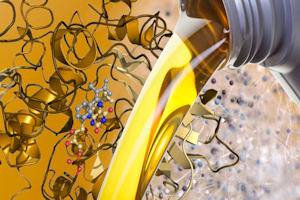
Scientists at The University of Manchester have made an important discovery that forms the basis for the development of new applications in biofuels and the sustainable manufacturing of chemicals. Based at the Manchester Institute of Biotechnology (MIB), researchers have identified the exact mechanism and structure of two key enzymes isolated from yeast moulds that together provide a new, cleaner route to the production of hydrocarbons.
Physics - Chemistry - 17.06.2015
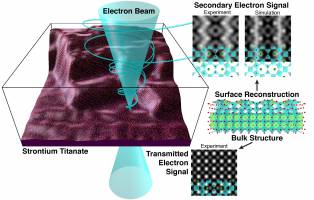
Technique for Studying the Atomic Structure of Material Surfaces Holds Promise for Catalysis, Corrosion and Other Critical Reactions For the first time in the long and vaunted history of scanning electron microscopy, the unique atomic structure at the surface of a material has been resolved. This landmark in scientific imaging was made possible by a new analytic technique developed by a multi-institutional team of researchers, including scientists from the U.S. Department of Energy (DOE)'s Lawrence Berkeley National Laboratory (Berkeley Lab).
Chemistry - Pharmacology - 17.06.2015
First complexation of multiple CO molecules to a non-metal atom
06/17/2015 For the first time, Würzburg scientists have successfully bound multiple carbon monoxide molecules to the main group element boron. They report on their work in the latest issue of the scientific journal Nature. Scientists of Professor Holger Braunschweig's team of the Institute of Inorganic Chemistry at the University of Würzburg have successfully bound two carbon monoxide molecules (CO) to the main group element boron in a direct synthesis for the first time.


Life Sciences - Today
Understanding the Brain - TU Ilmenau's EU EMBRACE Project Nominated for European Excellence Award
Understanding the Brain - TU Ilmenau's EU EMBRACE Project Nominated for European Excellence Award
Social Sciences - Today
A manual addresses, for the first time in Spain, child and adolescent sexual exploitation
A manual addresses, for the first time in Spain, child and adolescent sexual exploitation
Environment - Mar 26
Changing vegetation in thawing permafrost increases emissions of greenhouse gases
Changing vegetation in thawing permafrost increases emissions of greenhouse gases
Environment - Mar 26
University of Manchester hits major sustainability milestone, with Main Campus becoming 100% 'Zero Landfill'
University of Manchester hits major sustainability milestone, with Main Campus becoming 100% 'Zero Landfill'
Social Sciences - Mar 26
"It would be naive to believe that a social media ban will solve all problems"
"It would be naive to believe that a social media ban will solve all problems"
Health - Mar 26
Earlier detection, better outcomes: Irish researchers target rising bowel cancer rates with new blood test
Earlier detection, better outcomes: Irish researchers target rising bowel cancer rates with new blood test
Environment - Mar 26
UK must improve energy efficiency to end 50 years of policy failure and prevent future energy crises, study argues
UK must improve energy efficiency to end 50 years of policy failure and prevent future energy crises, study argues
Mathematics - Mar 26
From Materials to Medical Imaging, Fonseca's Work Shapes the Future of Innovation
From Materials to Medical Imaging, Fonseca's Work Shapes the Future of Innovation