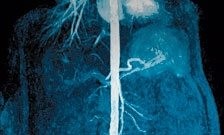
MRI scan of kidney
The MRC Centre for Transplantation has been awarded a £2.1 million grant from the Medical Research Council (MRC), to fund a three year clinical study into the efficacy of the drug Mirococept in renal transplantation. Last year, the team at King's announced that it had developed a technique to extend the life of a donor kidney; this involves perfusing the organ in a solution of Mirococept during the transfer from the donor to the recipient. Mirococept is engineered to stick within the organ during this process. The drug limits the action of a part of the immune system, known as the 'complement' system, which would normally attack and attempt to destroy cells from any intruder organism, including the cells of a donor organ. This is the first major clinical investigation into the usefulness of therapeutic regulation of the complement system in human renal transplantation using this approach, which could ultimately lead to extending the life of kidney transplants. Professor Steven Sacks, director of the Centre, said: 'The MRC has made it possible for us to try a completely new approach to protect donor kidneys at the time of transplantation, offering better prospect for a successful kidney treatment.' King's College London is one of the top 25 universities in the world (2010 QS international world rankings), The Sunday Times 'University of the Year 2010/11' and the fourth oldest in England. A research-led university based in the heart of London, King's has nearly 23,000 students (of whom more than 8,600 are graduate students) from nearly 140 countries, and some 5,500 employees.
TO READ THIS ARTICLE, CREATE YOUR ACCOUNT
And extend your reading, free of charge and with no commitment.