 © Alain Herzog / 2017 EPFL
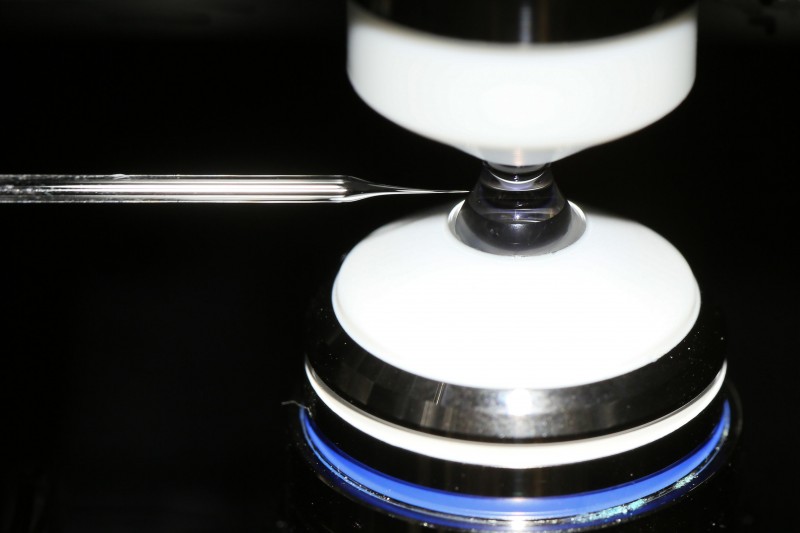
EPFL researchers have developed an optical imaging tool to visualize surface chemistry in real time. They imaged the interfacial chemistry in the microscopically confined geometry of a simple glass micro-capillary. The glass is covered with hydroxyl (-OH) groups that can lose a proton - a much-studied chemical reaction that is important in geology, chemistry and technology. A 100-micron long capillary displayed a remarkable spread in surface OH bond dissociation constant of a factor of a billion. Geological, catalytic, biological and chemical processes are driven by surface chemical heterogeneities, electrostatic fields and flow. To understand these processes and to enable the further development of new materials and microtechnology, researchers at EPFL's Laboratory for Fundamental BioPhotonics (LBP) have designed a microscope that can track, in real time, three-dimensional spatial changes in the molecular structure and chemistry of confined systems, such as curved surfaces and pores. The microscope was used to image the surface chemical structure of the inside of a glass microcapillary.
TO READ THIS ARTICLE, CREATE YOUR ACCOUNT
And extend your reading, free of charge and with no commitment.
Your Benefits
- Access to all content
- Receive newsmails for news and jobs
- Post ads