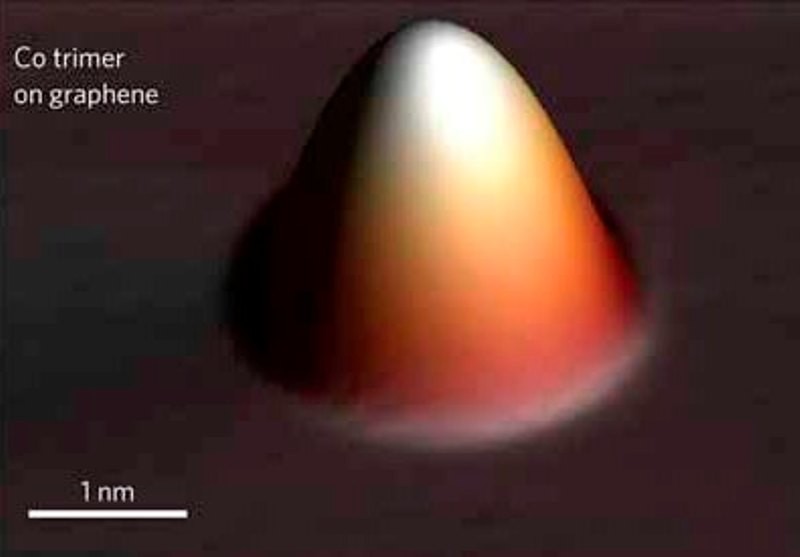
This zoom-in STM topograph shows one of the cobalt trimers placed on graphene for the creation of Coulomb potentials - charged impurities - to which electrons and holes could respond. (Image courtesy of Crommie group)
Perhaps no other material is generating as much excitement in the electronics world as graphene, sheets of pure carbon just one atom thick through which electrons can race at nearly the speed of light - 100 times faster than they move through silicon. Superthin, superstrong, superflexible and superfast as an electrical conductor, graphene has been touted as a potential wonder material for a host of electronic applications, starting with ultrafast transistors. For the vast potential of graphene to be fully realized, however, scientists must first learn more about what makes graphene so super. The latest step in this direction has been taken by researchers with the U.S. Department of Energy (DOE)'s Lawrence Berkeley National Laboratory (Berkeley Lab) and the University of California (UC) Berkeley. Michael Crommie, a physicist who holds joint appointments with Berkeley Lab's Materials Sciences Division and UC Berkeley's Physics Department, led a study in which the first direct observations at microscopic lengths were recorded of how electrons and holes respond to a charged impurity - a single Coulomb potential - placed on a gated graphene device. The results provide experimental support to the theory that interactions between electrons are critical to graphene's extraordinary properties. "We've shown that electrons in graphene behave very differently around charged impurities than electrons in other materials," Crommie says.
TO READ THIS ARTICLE, CREATE YOUR ACCOUNT
And extend your reading, free of charge and with no commitment.