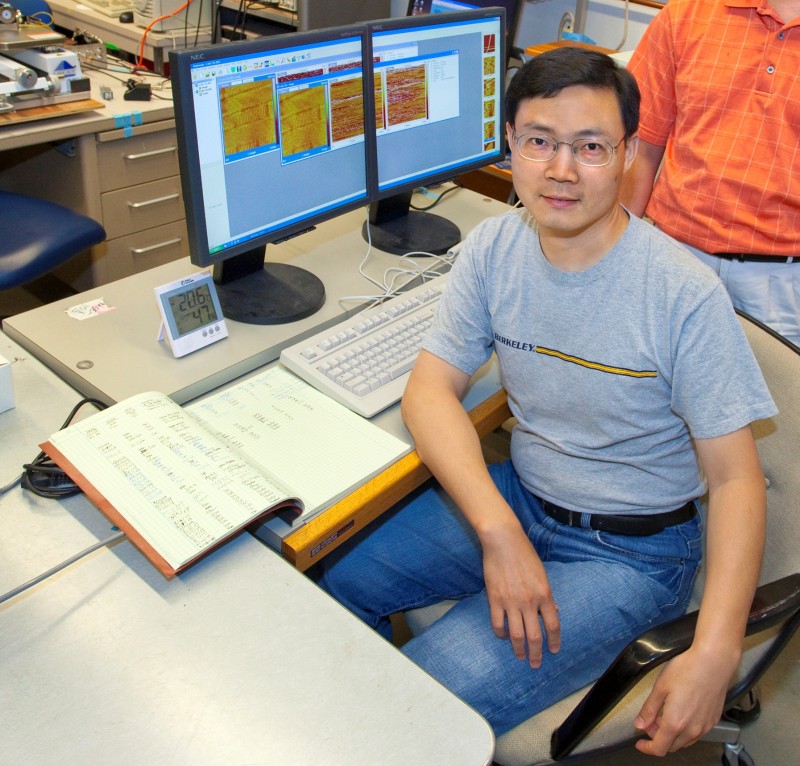
Junqiao Wu is a physicist who holds joint appointments with Berkeley Lab’s Materials Sciences Division and UC-Berkeley’s Department of Materials Science and Engineering. (Photo by Roy Kaltschmidt)
Vanadium Dioxide Micro-Muscle - This movie shows a vanadium dioxide-based micro-muscle functioning first in micro-catapult mode, throwing out an object, and then in micro-explosion mode, whereby it senses a proximate object and reacts by pushing the object away. (Movie courtesy of Junqiao Wu group, Berkeley Lab/UC Berkeley) Vanadium dioxide is poised to join the pantheon of superstars in the materials world. Already prized for its extraordinary ability to change size, shape and physical identity, vanadium dioxide can now add muscle power to its attributes. A team of researchers with the U.S. Department of Energy (DOE)'s Lawrence Berkeley National Laboratory (Berkeley Lab) has demonstrated a micro-sized robotic torsional muscle/motor made from vanadium dioxide that for its size is a thousand times more powerful than a human muscle, able to catapult objects 50 times heavier than itself over a distance five times its length within 60 milliseconds - faster than the blink of an eye. "We've created a micro-bimorph dual coil that functions as a powerful torsional muscle, driven thermally or electro-thermally by the phase transition of vanadium dioxide," says the leader of this work, Junqiao Wu, a physicist who holds joint appointments with Berkeley Lab's Materials Sciences Division and the University of California-Berkeley's Department of Materials Science and Engineering. "Using a simple design and inorganic materials, we achieve superior performance in power density and speed over the motors and actuators now used in integrated micro-systems." Wu is the corresponding author of a paper describing this research in the journal Advanced Materials.
TO READ THIS ARTICLE, CREATE YOUR ACCOUNT
And extend your reading, free of charge and with no commitment.