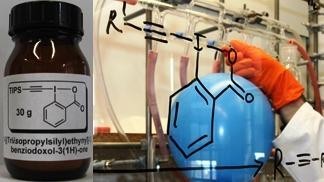
Scientists at EPFL have developed a quick and simple method for connecting and assembling new molecules together, paving a new road for synthetic chemistry, material science, chemical biology, and even drug discovery. Thiols are sulfur-containing molecules found in most proteins of the human body. Characterized by their 'garlicky' smell, they also give coffee, sweat and the spray of skunks their unique odor. Because they are so widespread in biology, medicine and materials science, thiols are ideal targets for connecting molecules like drugs or polymers together, except that they must first be fitted with a chemical group that acts like an adaptor to other molecules. One of the most potentially useful of these 'adaptors' are the alkynes, which can be extremely powerful in bioconjugation. The problem is that adding alkynes to thiols ('alkynylation') has been too difficult to be of any use outside the lab. But now, in a patent-pending publication in the Journal of the American Chemical Society , EPFL scientists have found a way to make the connection in five minutes and at room temperature, paving the way to commercial, medical and perhaps industrial applications.
TO READ THIS ARTICLE, CREATE YOUR ACCOUNT
And extend your reading, free of charge and with no commitment.
Your Benefits
- Access to all content
- Receive newsmails for news and jobs
- Post ads