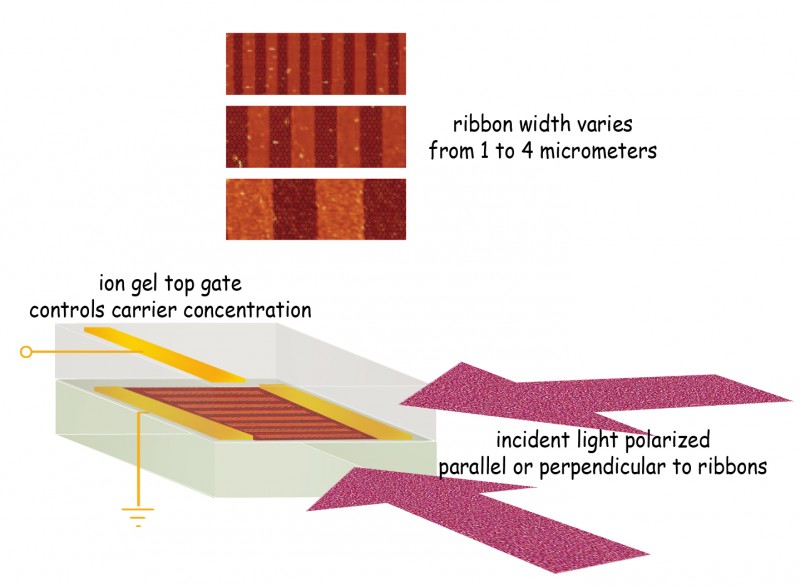
The graphene microribbon array can be tuned in three ways. Varying the width of the ribbons changes plasmon resonant frequency and absorbs corresponding frequencies of terahertz light. Plasmon response is much stronger when there is a dense concentration of charge carriers (electrons or holes), controlled by varying the top gate voltage. Finally, light polarized perpendicularly to the ribbons is strongly absorbed at the plasmon resonant frequency, while parallel polarization shows no such response. (Click on image for best resolution.)
Long-wavelength terahertz light is invisible - it's at the farthest end of the far infrared - but it's useful for everything from detecting explosives at the airport to designing drugs to diagnosing skin cancer. Now, for the first time, scientists at the U.S. Department of Energy's Lawrence Berkeley National Laboratory (Berkeley Lab) and the University of California at Berkeley have demonstrated a microscale device made of graphene - the remarkable form of carbon that's only one atom thick - whose strong response to light at terahertz frequencies can be tuned with exquisite precision. "The heart of our device is an array made of graphene ribbons only millionths of a meter wide," says Feng Wang of Berkeley Lab's Materials Sciences Division, who is also an assistant professor of physics at UC Berkeley, and who led the research team. "By varying the width of the ribbons and the concentration of charge carriers in them, we can control the collective oscillations of electrons in the microribbons." The name for such collective oscillations of electrons is "plasmons," a word that sounds abstruse but describes effects as familiar as the glowing colors in stained-glass windows. "Plasmons in high-frequency visible light happen in three-dimensional metal nanostructures," Wang says. The colors of medieval stained glass, for example, result from oscillating collections of electrons on the surfaces of nanoparticles of gold, copper, and other metals, and depend on their size and shape.
TO READ THIS ARTICLE, CREATE YOUR ACCOUNT
And extend your reading, free of charge and with no commitment.