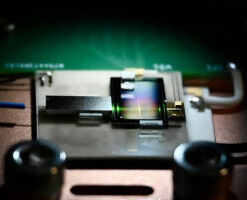
Affordable detectors for gamma radiation
A research team at Empa and ETH Zurich has developed single crystals made of lead halide perovskites, which are able to gage radioactive radiation with high precision. Initial experiments have shown that these crystals, which can be manufactured from aqueous solutions or low-priced solvents, work just as well as conventional cadmium telluride semi-conductors, which are considerably more complicated to produce. The discovery could slash the price of many radio-detectors - such as in scanners in the security sector, portable dosimeters in power stations and measuring devices in medical diagnostics. Gamma photons virtually always accompany the radioactive decay of unstable isotopes. In order to identify radioactive substances, cost-effective and highly sensitive gamma detectors that work at room temperature are thus in great demand. Finding suitable substances, however, is easier said than done, as Maksym V. Kovalenko, a professor at ETH Zurich and research group leader at Empa explains: the coveted semiconductor has to be of an outstanding electronic quality, i.e. exhibit a high mobility and lifetime of carriers, along with a low density of trap states as well as of intrinsic carriers at room temperature. Second, it must be composed of heavy elements that can absorb highly energetic gamma photons.