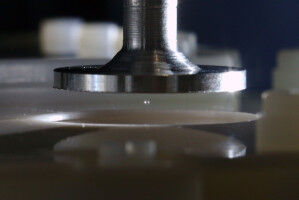
The experimental apparatus used in this study © F. Carbone
23. EPFL researchers have developed a way to explore and optimize gold nanoparticles, which are used in medicine, biology and solar cells. Artists have used gold nanoparticles for centuries, because they produce vibrant colors when sunlight hits them. Their unique optical-electronics properties have put gold nanoparticles at the center of research, solar cells, sensors, chemotherapy, drug delivery, biological and medical applications, and electronic conductors. The properties of gold nanoparticles can be tuned by changing their size, shape, surface chemistry etc., but controlling these aspects is difficult. Publishing in Nano Letters , researchers led by Fabrizio Carbone at EPFL have made an unprecedented study into the structure of gold nanoparticles. Working with Francesco Stellacci's lab (EPFL), the researchers achieved this using a device called "small-angle time-resolved electron diffractometer", which allowed them to study the structural arrangements of gold nanoparticles at ultrafast speeds - quadrillionths of a second.
TO READ THIS ARTICLE, CREATE YOUR ACCOUNT
And extend your reading, free of charge and with no commitment.
Your Benefits
- Access to all content
- Receive newsmails for news and jobs
- Post ads