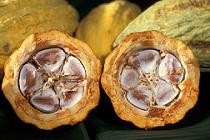
Cocoa beans in a cacao pod.
University Park, Pa. The sequencing and analysis of the genome for the Criollo variety of the cacao tree, generally considered to produce the world's finest chocolate, was completed by an international team led by Claire Lanaud of CIRAD, France, with Mark Guiltinan of Penn State, and included scientists from 18 other institutions. "The large amount of information generated by this project dramatically changes the status of this tropical plant and its potential interest for the scientific community," said Guiltinan, professor of plant molecular biology, Penn State. The researchers not only sequenced the genome of this ancient plant, but assembled 76 percent of the genome linking 82 percent of those genes to the 10 cacao chromosomes. This analysis identified a variety of gene families that may have future impact on improving cacao trees and fruit either by enhancing their attributes or providing protection from fungal diseases and insects that effect cacao trees. "Relics of the ancestral Criollo first cultivated by Olmec or Maya people can still be encountered in old Mesoamerican plantations or in forests where the Maya live," said Siela Maximova, associate professor of horticulture and a member of the research team. "Our genome sequence is derived form a Belizean Criollo plant collected in the Mayan mountains." Cocoa production began in Mesoamerica 3,000 years ago, and the Criollo variety was the first domesticated.
TO READ THIS ARTICLE, CREATE YOUR ACCOUNT
And extend your reading, free of charge and with no commitment.