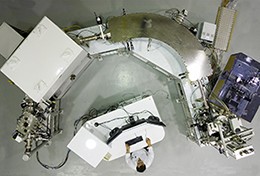
Sensitive High Resolution Ion Micro Probes (SHRIMP IIe).
Researchers in Japan and Poland will get the keys to help unlock the mysteries of our origins thanks to a machine developed by The Australian National University. The Polish Geological Institute and the Japanese Geological Survey, will soon become the new owners of Sensitive High Resolution Ion Micro Probes (SHRIMP IIe) which allows researchers to look back billions of years in time to address longstanding questions about the geological history of the Earth. The machine is the latest in a series of large ion microprobes developed jointly by Australian Scientific Instruments (ASI) a division of ANU Enterprise and part of the broader ANU Innovation portfolio, and the Research School of Earth Sciences in the ANU College of Physical and Mathematical Sciences. The SHRIMP IIe provides high resolution information on microscopic samples, allowing precise dating and insight into a region's geology. The application of the SHRIMP IIe has been extended from geochronology (dating), to more general geochemistry, enabling scientists to explore questions such as the early history of the solar system. Ed Roberts, General Manager of ASI, said the sale of the two SHRIMP's was important for not just ASI, but also for ANU Enterprise, ANU, and the local community. "Canberra benefits because of the direct and indirect employment provided by ASI.
TO READ THIS ARTICLE, CREATE YOUR ACCOUNT
And extend your reading, free of charge and with no commitment.