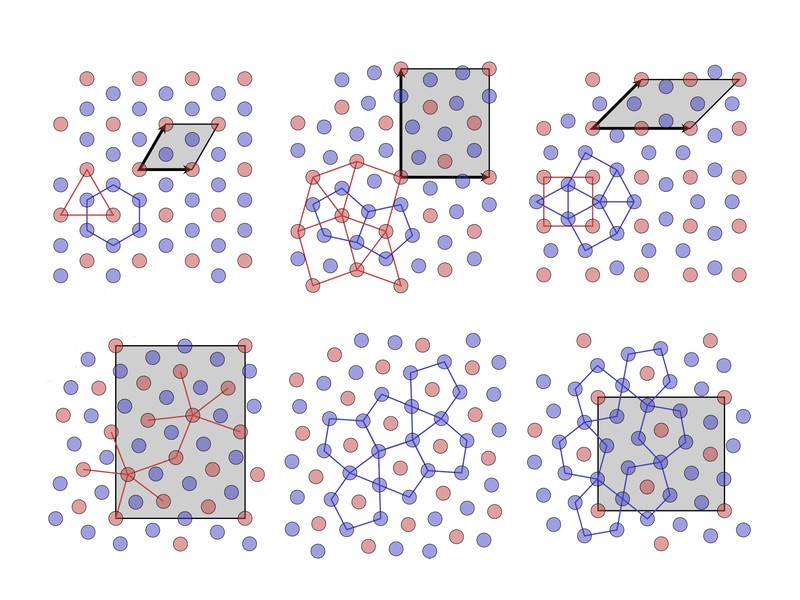
Ganz unterschiedliche Strukturen können die Teilchen ausbilden, die sich zwischen zwei geladenen Platten befinden.
Charged particles can form via self-organization processes an unexpectedly large range of crystal structures entirely by themselves. A research team with participants from TU Wien has demonstrated how easily the formation of these structures can be controlled via external parameters. A huge and colourful variety of crystals can be found in nature - from simple salt crystals to iridescent opals and biological crystals that are responsible for the glorious colouring on butterflies? wings. New technological methods have made it possible to expand the range of crystals even further. 'Colloidal systems? often consist of particles that are able to form ordered structures entirely by themselves via so-called self-organization. A research team with participants from TU Wien has now demonstrated that you can make particles that form an astonishingly large number of completely different crystal structures between two charged plates. Slight changes in the distance between these plates or their electrical charge causes the particles to form a completely different pattern.
TO READ THIS ARTICLE, CREATE YOUR ACCOUNT
And extend your reading, free of charge and with no commitment.