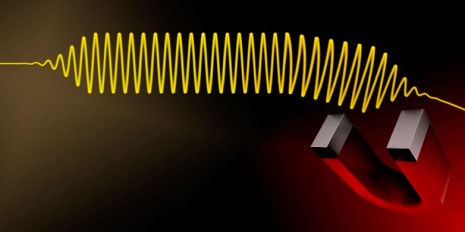
Photons are usually insensitive to magnetic fields. However, their propagation can be steered by electric and magnetic fields while they propagate in a solid medium. (Visualisations: Colourbox / Montage Josef Kuster)
Light particles do not usually react to magnetic fields. Researchers at ETH Zurich have now shown how photons can still be influenced by electric and magnetic fields. In the future that method could be used to create strong artificial magnetic fields for photons. In modern information technology there is a rather clear division of labour between light particles (photons), used for transmitting data fast and reliably over large distances, and electrons, which are responsible for data processing in computer chips. One reason why photons are not used for data processing is that they cannot be steered as easily as electrons. Since they have no electric charge they cannot be straightforwardly controlled using electric or magnetic fields. A group of researchers at ETH Zurich led by Ataç Imamo'lu, a professor at the Institute for Quantum Electronics, have now experimentally shown how to produce artificial magnetic fields that allow one indirectly to control photons.
TO READ THIS ARTICLE, CREATE YOUR ACCOUNT
And extend your reading, free of charge and with no commitment.