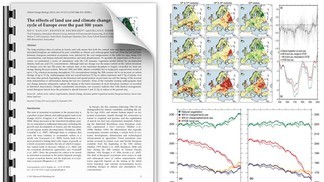
ARVE researchers at EPFL/ENAC publish in "Global Change Biology" on the effects of land use and climate change on the carbon cycle of Europe over the past 500 years! Learn more on http://arve.epfl.ch/news - The long residence time of carbon in forests and soils means that both the current state and future behavior of the terrestrial biosphere are influenced by past variability in climate and anthropogenic land use. Over the last half-millennium, European terrestrial ecosystems were affected by the cool temperatures of the Little Ice Age, rising CO2 concentrations, and human induced deforestation and land abandonment. To quantify the importance of these processes, we performed a series of simulations with the LPJ dynamic vegetation model driven by reconstructed climate, land use, and CO2 concentrations. Although land use change was the major control on the carbon inventory of Europe over the last 500 years, the current state of the terrestrial biosphere is largely controlled by land use change during the past century. Between 1500 and 2000, climate variability led to temporary sequestration events of up to 3 Pg, whereas increasing atmospheric CO2 concentrations during the 20th century led to an increase in carbon storage of up to 15 Pg. Anthropogenic land use caused between 25 Pg of carbon emissions and 5 Pg of uptake over the same time period, depending on the historical and spatial pattern of past land use and the timing of the reversal from deforestation to afforestation during the last two centuries.
TO READ THIS ARTICLE, CREATE YOUR ACCOUNT
And extend your reading, free of charge and with no commitment.
Your Benefits
- Access to all content
- Receive newsmails for news and jobs
- Post ads