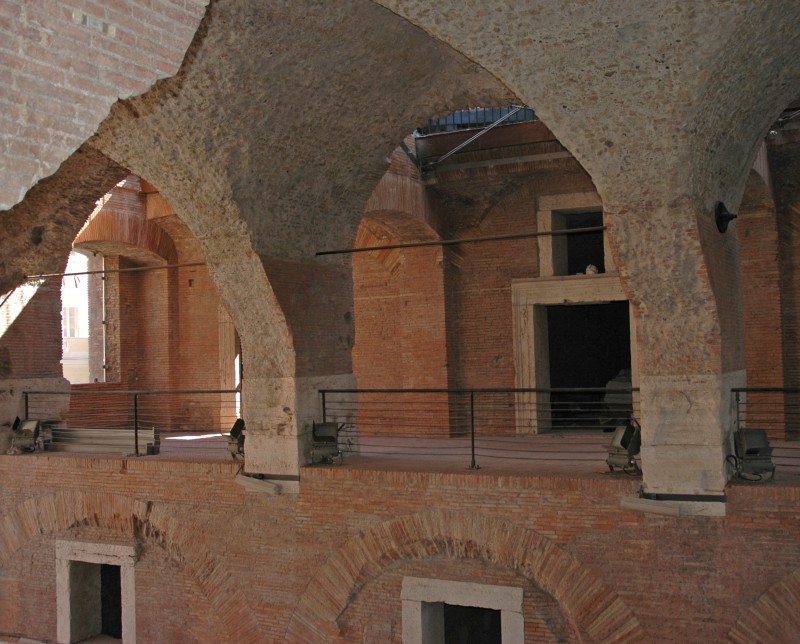
The concrete walls of Trajan’s Markets in Rome have stood the test of time and the elements for nearly 2,000 years. They have even survived a major earthquake in 1349. (Photo courtesy of Marie Jackson)
No visit to Rome is complete without a visit to the Pantheon, Trajan's Markets, the Colosseum, or the other spectacular examples of ancient Roman concrete monuments that have stood the test of time and the elements for nearly two thousand years. A key discovery to understanding the longevity and endurance of Roman architectural concrete has been made by an international and interdisciplinary collaboration of researchers using beams of X-rays at the Advanced Light Source (ALS) of the U.S. Department of Energy (DOE)'s Lawrence Berkeley National Laboratory (Berkeley Lab). Working at ALS beamline 12.3.2, a superconducting bending magnet X-ray micro-diffraction beamline, the research team studied a reproduction of Roman volcanic ash-lime mortar that had been previously subjected to fracture testing experiments at Cornell University. In the concrete walls of Trajan's Markets, constructed around 110 CE, this mortar binds cobble-sized fragments of tuff and brick. Through observing the mineralogical changes that took place in the curing of the mortar over a period of 180 days and comparing the results to 1,900 year old samples of the original, the team discovered that a crystalline binding hydrate prevents microcracks from propagating. "The mortar resists microcracking through in situ crystallization of platy strätlingite, a durable calcium-alumino-silicate mineral that reinforces interfacial zones and the cementitious matrix," says Marie Jackson, a faculty scientist with the University of California (UC) Berkeley's Department of Civil and Environmental Engineering who led this study.
TO READ THIS ARTICLE, CREATE YOUR ACCOUNT
And extend your reading, free of charge and with no commitment.