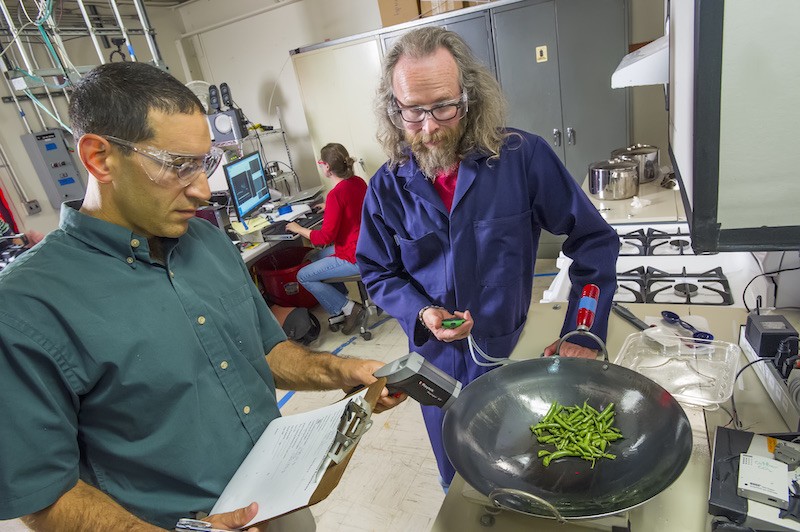
Brett Singer (left) helps lead Berkeley Lab’s research on range hoods and indoor air quality. (Credit: Berkeley Lab)
California has established ambitious goals to reduce energy consumption in buildings, including a policy goal for all new residential buildings to be zero net energy (ZNE) by 2020. Now the Department of Energy's Lawrence Berkeley National Laboratory (Berkeley Lab) has launched two projects to help the state meet its ZNE building goals. One project will provide detailed cost and performance modeling of ZNE homes and identify barriers while the other seeks to ensure acceptable indoor air quality in ZNE homes that use natural gas. The California Energy Commission (CEC) is providing $2 million in funding for the two projects. The DOE's Building America program is also supporting the air quality project, the results of which will inform DOE's Zero Energy Ready Home program. ZNE buildings essentially generate as much as they consume on an annualized basis, and California has led the way in the United States in laying the path towards ultra-low energy buildings. Carbon dioxide emissions from residential and commercial buildings make up about 23 percent of the state's overall greenhouse gas emissions, of which about 14 percent are from electricity generation sources and 9 percent from building heating fuels.
TO READ THIS ARTICLE, CREATE YOUR ACCOUNT
And extend your reading, free of charge and with no commitment.