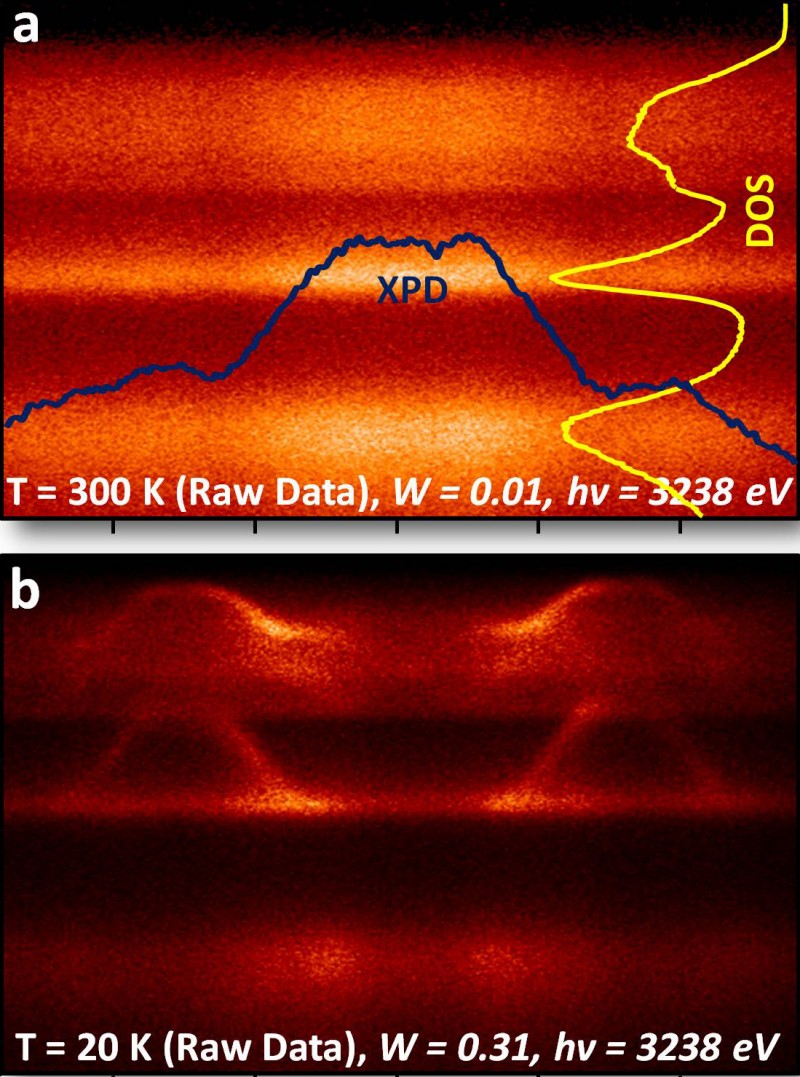
By collecting and comparing HARPES data at room and cryo temperatures, Berkeley Lab researchers were able to correct for density of state (DOS) and x-ray photoelectron diffraction (XPD) influences in determining electronic structures deep below sample surfaces. (Image from Fadley group)
The expression "beauty's only skin-deep" has often been applied to the chemistry of materials because so much action takes place at the surface. However, for many of the materials in today's high technologies, such as semiconductors and superconductors, once a device is fabricated it is the electronic structures below the surface, in the bulk of the material or in buried layers, that determine its effectiveness. For the past 30 years, one of the most valuable and widely used techniques for studying electronic structures has been ARPES - Angle-Resolved PhotoEmission Spectroscopy. However, this technique primarily looks at surfaces. Now, for the first time, bulk electronic structures have been opened to comparable scrutiny through a new variation of this standard called HARPES - Hard x-ray Angle-Resolved PhotoEmission Spectroscopy - whose development was led by researchers with the U.S. Department of Energy (DOE)'s Lawrence Berkeley National Laboratory (Berkeley Lab). "HARPES should enable us to study the electronic structure of any new material in the bulk, with minimum effects of surface reactions or contamination," says physicist Charles Fadley who led the development of HARPES. "Our technique should also allow us to probe the buried layers and interfaces that are ubiquitous in nanoscale devices, and are key to smaller logic elements in electronics, novel memory architectures in spintronics, and more efficient energy conversion in such technologies as photovoltaic cells." Fadley is a physicist who holds joint appointments with Berkeley Lab's Materials Sciences Division and the University of California (UC) Davis where he is a Distinguished Professor of Physics.
TO READ THIS ARTICLE, CREATE YOUR ACCOUNT
And extend your reading, free of charge and with no commitment.