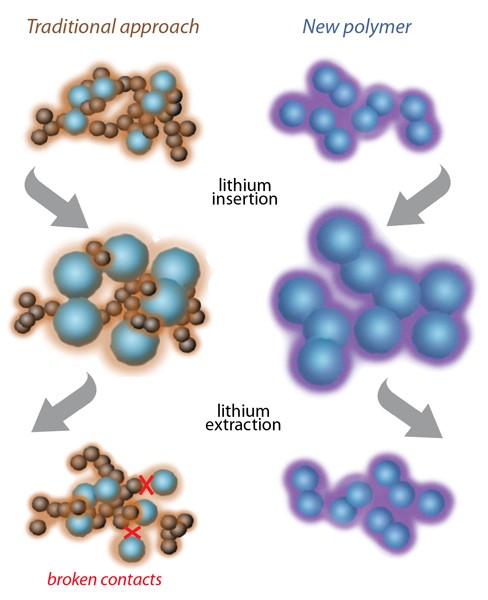
At left, the traditional approach to composite anodes using silicon (blue spheres) for higher energy capacity has a polymer binder such as PVDF (light brown) plus added particles of carbon to conduct electricity (dark brown spheres). Silicon swells and shrinks while acquiring and releasing lithium ions, and repeated swelling and shrinking eventually break contacts among the conducting carbon particles. At right, the new Berkeley Lab polymer (purple) is itself conductive and continues to bind tightly to the silicon particles despite repeated swelling and shrinking.
Lithium-ion batteries are everywhere, in smart phones, laptops, an array of other consumer electronics, and the newest electric cars. Good as they are, they could be much better, especially when it comes to lowering the cost and extending the range of electric cars. To do that, batteries need to store a lot more energy. The anode is a critical component for storing energy in lithium-ion batteries. A team of scientists at the U.S. Department of Energy's Lawrence Berkeley National Laboratory (Berkeley Lab) has designed a new kind of anode that can absorb eight times the lithium of current designs, and has maintained its greatly increased energy capacity after over a year of testing and many hundreds of charge-discharge cycles. The secret is a tailored polymer that conducts electricity and binds closely to lithium-storing silicon particles, even as they expand to more than three times their volume during charging and then shrink again during discharge. The new anodes are made from low-cost materials, compatible with standard lithium-battery manufacturing technologies.
TO READ THIS ARTICLE, CREATE YOUR ACCOUNT
And extend your reading, free of charge and with no commitment.