Blaine Friedlander/Cornell Chronicle
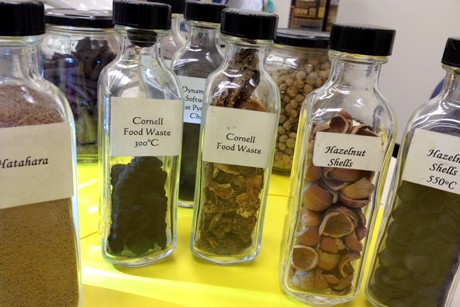
In the quest to decrease the world's greenhouse gases, Cornell scientists have discovered that biochar - a charcoal-like substance - reduces the nemesis nitrous oxide from agricultural soil on average by about 55 percent and stanches emissions into the atmosphere. The research is reported in the new journal from Nature, Scientific Reports, April 25. 'We investigated the mechanics of denitrification, with particular attention to the climate-relevant nitrous oxide by adding biochar to agricultural soils,' says senior author Johannes Lehmann, Cornell professor of soil science. 'Biochar consistently reduced nitrous oxide emission in agricultural soils.' - Carbon dioxide has a quiet, but strong partner in climate-warming crime - nitrous oxide. This nasty gas is usually produced on farms from animal manure waste and the use of synthetic fertilizer. In fact, nitrous oxide in agricultural soil has 298 times more global warming potential than carbon dioxide. 'Hence the importance to reduce emissions,' says Lehmann.
TO READ THIS ARTICLE, CREATE YOUR ACCOUNT
And extend your reading, free of charge and with no commitment.