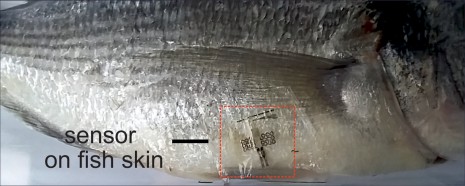
The sensor also adheres to fish skin and would help monitor the freshness of a cargo. (Picture: from Salvatore et al, Adv. Func. Materials, 2017)
A new generation of microsensors could provide the vital link between food products and the Internet of Things. ETH researchers have developed an ultra-thin temperature sensor that is both biocompatible and biodegradable. Nowadays microsensors are already used in many different applications, such as the detection of poisonous gases. They are also integrated into miniaturised transmitter/receiver systems, such as the ubiquitous RFID chips. However, as the sensors often contain precious metals that are harmful to both the environment and human health, they are not suitable for medical applications involving direct contact with the human body or for inclusion in food products. There is therefore a high level of interest, both in research and industry, in developing microsensors made from non-toxic materials that are also biodegradable. Magnesium wire and compostable polymer .
TO READ THIS ARTICLE, CREATE YOUR ACCOUNT
And extend your reading, free of charge and with no commitment.