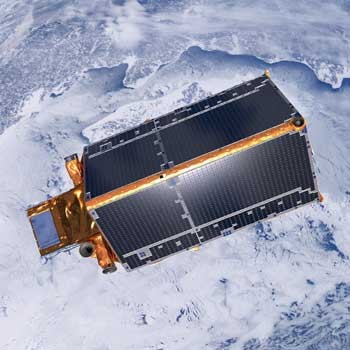
artist’s impression of CryoSat-2 in orbit (credit: ESA)
A UCL-led satellite mission designed to monitor changes in polar ice cover launched successfully on Thursday 8 April from the Baikonur cosmodrome in Kazakhstan. The European Space Agency's CryoSat-2 will measure the thickness of Arctic and Antarctic ice with unprecedented accuracy and tell scientists how melting polar ice affects ocean circulation patterns, sea level and global climate. CryoSat-2 chief scientist Professor Duncan Wingham (UCL Earth Sciences), who is based at the Centre for Polar Observation and Modelling at UCL, first proposed the satellite in 1999. He said: 'Satellites have transformed our knowledge of what is happening to these distant and uninhabited parts of the planet. CryoSat-2 will help unravel the consequences of the dramatic changes in the poles that we've seen in the past two decades.' CryoSat-1 failed to launch in 2005 but Professor Wingham and his colleagues say measurements from its successor are crucially important for scientists at the National Centre for Earth Observation, who are at the forefront of monitoring Earth's changing ice cover. CryoSat-2 will use an instrument called an altimeter to measure ice thickness. This works by recording the time it takes for pulses of microwave energy fired down at the ice to return to the satellite.
TO READ THIS ARTICLE, CREATE YOUR ACCOUNT
And extend your reading, free of charge and with no commitment.