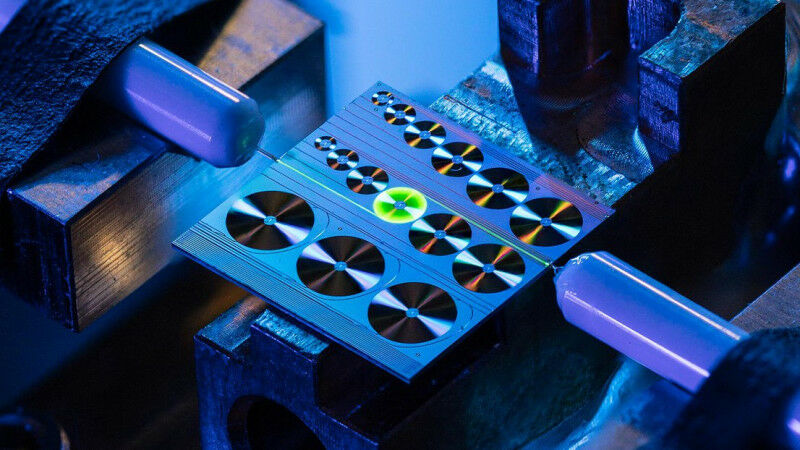
An erbium-doped waveguide amplifier on a photonic integrated chip. Credit: EPFL Laboratory of Photonics and Quantum Measurements/Niels Ackerman
An erbium-doped waveguide amplifier on a photonic integrated chip. Credit: EPFL Laboratory of Photonics and Quantum Measurements/Niels Ackerman - Scientists have built a compact waveguide amplifier by successfully incorporating rare-earth ions into integrated photonic circuits. The device produces record output power compared to commercial fiber amplifiers, a first in the development of integrated photonics over the last decades. Erbium-doped fiber amplifiers (EDFAs) are devices that can provide gain to the optical signal power in optical fibers, often used in long-distance communication fiber optic cables and fiber-based lasers. Invented in the 1980s, EDFAs are arguably one of the most important inventions, and have profoundly impacted our information society enabling signals to be routed across the Atlantic and replacing electrical repeaters. What is interesting about erbium ions in optical communications is that they can amplify light in the 1.55 mm wavelength region, which is where silica-based optical fibers have the lowest transmission loss. The unique electronic intra-4-f shell structure of erbium - and rare-earth ions in general - enables long-lived excited states when doped inside host materials such as glass.
TO READ THIS ARTICLE, CREATE YOUR ACCOUNT
And extend your reading, free of charge and with no commitment.