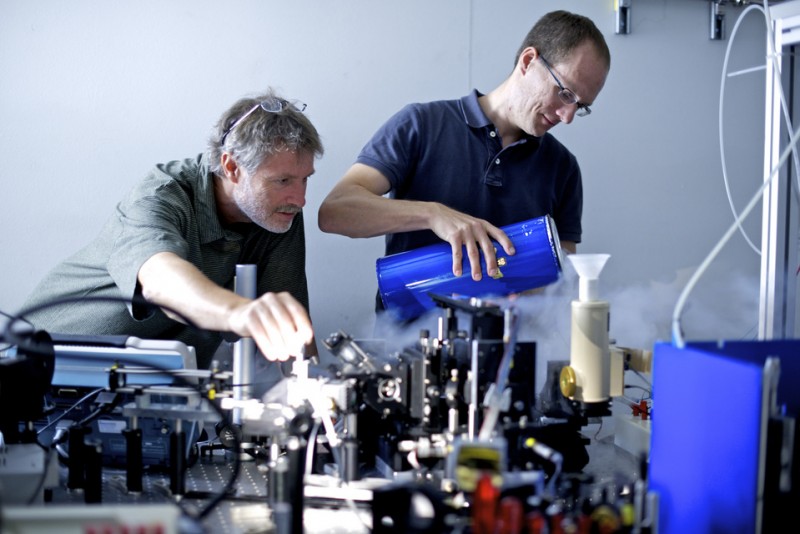
Peter Friedli and Hans Sigg preparing the experiment at the Infrared Beamline at the SLS for determining the laser properties of Germanium. (Photo: Frank Reiser, Paul Scherrer Institut)
Paul Scherrer Institute (PSI) researchers have investigated how they could make the semiconductor Germanium emit laser light. As a laser material, Germanium together with Silicon could form the basis for innovative computer chips in which information would be transferred partially in the form of light. This technology would revolutionise data streaming within chips and give a boost to the performance of electronics. The researchers have demonstrated that Germanium must be put under strain by an external force in order to turn it into a laser material. The decisive investigations were carried out by the scientists at the Swiss Light Source (SLS) at PSI and their results have recently appeared in the scientific journal 'Physical Review Letters'. The research was supported by the Swiss National Science Foundation (SNSF). In 1965, Gordon Moore proposed a law stating that the surface density of transistors in computer chips - and consequently their computing power - would double every two years.
TO READ THIS ARTICLE, CREATE YOUR ACCOUNT
And extend your reading, free of charge and with no commitment.