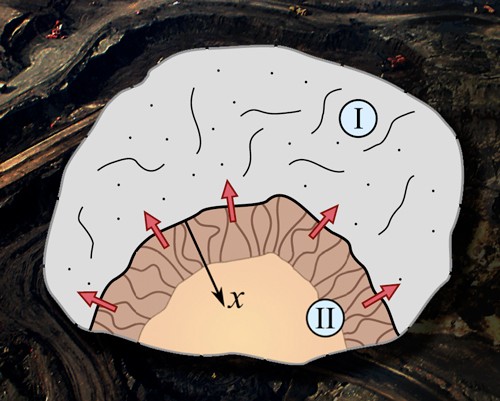
The model developed by Monteiro, Rycroft, and Barenblatt posits a porous, fissurized matrix (I) with enough permeability to be treated by standard fluid mechanics, as well as a kerogen inclusion (II) with very low permeability. During mining, a boundary layer of flow forms in the kerogen, as shown by the textured brown strip. Fluid moves out of the inclusion, indicated by the red arrows. The evolution of the boundary layer, analyzed along the coordinate labeled X, is key to the rate and longevity of the formation’s productivity.
Given that over 20 trillion cubic meters of natural gas, a third of the United States' total reserves, are thought to be trapped in shale, and given the rush to exploit shale oil and gas resources by Australia, Canada, China, and other countries around the world-even oil-rich Saudi Arabia-it's a wonder that producers still rely on models of how fluids flow underground that were devised in the heyday of oil and gas development. Shale is a sedimentary rock thought to be formed from silt deposited in still waters, consisting of layered, fine-grained clay minerals and, often, organic matter such as kerogen, the source of oil and gas. Until now, no mathematical model of gas reservoirs has explicitly incorporated kerogen in calculating how the gas and oil become available and how long a reservoir is liable to keep producing. The onset of large-scale shale mining calls for a new approach, and the call has been answered by Paulo Monteiro, Chris Rycroft, and Grigory Isaakovich Barenblatt in recent research describing a mathematical model of fluid and gas flow in nanoporous media. Monteiro, Rycroft, and Barenblatt are with the Lab's Computational Research Division and UC Berkeley's Department of Civil and Environmental Engineering; Monteiro is also with Berkeley Lab's Advanced Light Source, and Barenblatt is also with the Russian Academy of Science's Institute of Oceanology. The authors studied the physical structure of shales and posited a general structure with two components. One is the fine-clay matrix, ordinary rock with nanoscale pores (pores whose dimensions are measured in billionths of a meter) and fissures.
TO READ THIS ARTICLE, CREATE YOUR ACCOUNT
And extend your reading, free of charge and with no commitment.