Jason Koski/University Photography
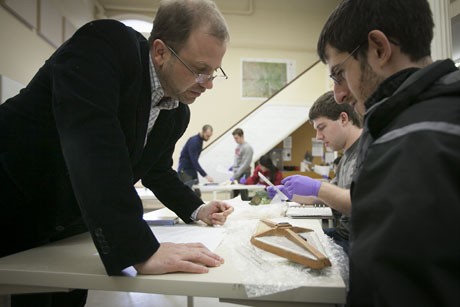
"Welcome to Cornell Ruins National Park," Adam T. Smith tells his students. "We're lucky today. We have a cache of objects to examine discovered in the ruins of McGraw Hall." This "Rise and Fall of 'Civilization'" class examines traditional archaeological topics, like kingship and the origins of cities, partly by looking at our current civilization through the lens of a single site - the Cornell campus as it would look 1,000 years from now. "Archaeology is typically done overseas or on sites far removed from the classroom," says Smith, professor of anthropology in the College of Arts and Sciences. "The Cornell ruins project brings archaeology to campus. Students can imagine the trash they find accumulating over hundreds of years and slowly being accreted, which is how an archaeological site forms." The McGraw Hall "cache" is actually part of the Llhuros Collection, "artifacts" from a mythical civilization created in the 1970s by the late Norman Daly, Cornell professor of art. Working with Daly's son, David Daly, Smith has brought a selection of Llhuros items to his class in the Landscapes and Objects Laboratory in McGraw Hall.
TO READ THIS ARTICLE, CREATE YOUR ACCOUNT
And extend your reading, free of charge and with no commitment.