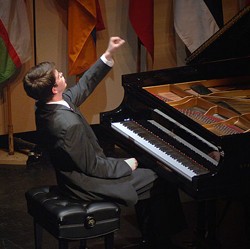
’Stephen Beus performs in the 2006 Gina Bachauer International Piano Competition’ on Wikimedia Commons
People can reliably select the winners of classical music competitions based on silent video recordings of performances, according to new research from UCL. However, the study also finds that neither classical music novices nor professional musicians are able to identify the winners of competitions based on sound recordings alone. The results highlight the perhaps uncomfortable finding that we rely more on visual information when judging a music performance than the sound of the music itself. Visual cues, such as the perception of a performer's "passion" or "involvement", were found to be good predictors of winning performances according to the results of Dr Chia-Jung Tsay, author of the study from (UCL Management Science and Innovation), and a concert pianist, said: "Classical music training is often focused on improving the quality of the sound, but this research is about getting to the bottom of what is really being evaluated at the highest levels of competitive performance." - It's unsettling to find - and for musicians not to know - that they themselves relegate the sound of music to the role of noise. Dr Chia-Jung Tsay (UCL Management Science & Innovation) "The results show that even when we want to be objective in evaluating the sound of music, when it comes to live performance, the visual experience can be the most influential aspect.
TO READ THIS ARTICLE, CREATE YOUR ACCOUNT
And extend your reading, free of charge and with no commitment.