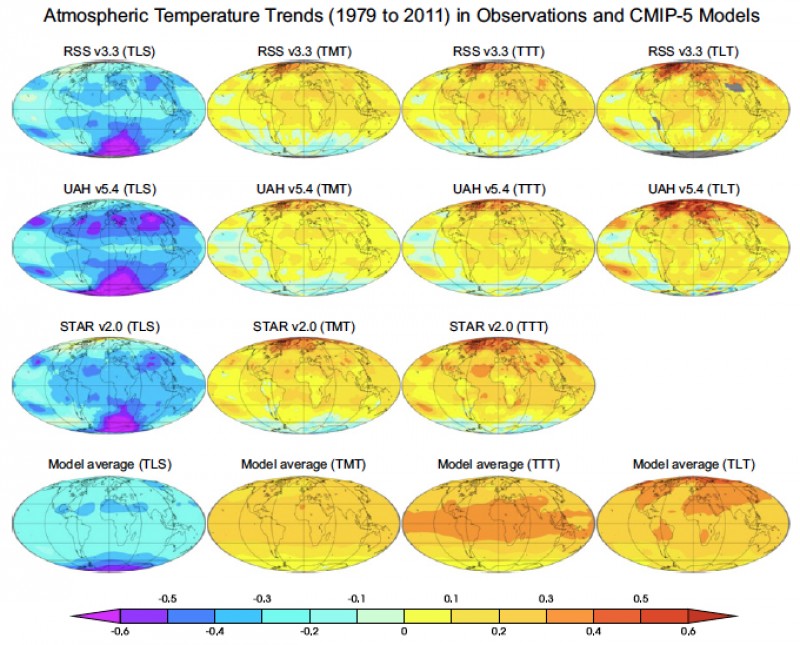
Geographical patterns of observed and simulated trends (in degrees Celsius per decade) from 1979 to 2011. Abbreviations stand for the lower stratosphere (TLS), the mid- to upper troposphere (TMT), and the lower troposphere (TLT). The observations are measurements of microwave emissions made by microwave sounding units (MSUs) on polar-orbiting satellites. MSU-based temperature data came from three different observational groups: Remote Sensing Systems (RSS), the University of Alabama at Huntsville (UAH), and the Center for Satellite Applications and Research (STAR) in Maryland. (Courtesy Benjamin Santer, LLNL)
New research shows some of the clearest evidence yet of a discernible human influence on atmospheric temperature. Published online in the Nov. 29 early edition of the Proceedings of the U.S. National Academy of Sciences , the study compared 20 of the latest climate models against 33 years of satellite data. When human factors were included in the models, they followed the pattern of temperature changes observed by satellite. When the same simulations were run without considering human influences, the results were quite different. "We can only match the satellite record when we add in human influences on the atmosphere," said Michael Wehner, a research scientist at Lawrence Berkeley National Laboratory (Berkeley Lab) Computational Research Division and a coauthor of the article, which involved colleagues from 16 other organizations and was led by Benjamin Santer, an atmospheric scientist at Lawrence Livermore National Laboratory (LLNL). Because the differences were so marked between models run with and without human influences, "we can conclude that these differences are unlikely to be due to natural causes with a high degree of certainty.
TO READ THIS ARTICLE, CREATE YOUR ACCOUNT
And extend your reading, free of charge and with no commitment.