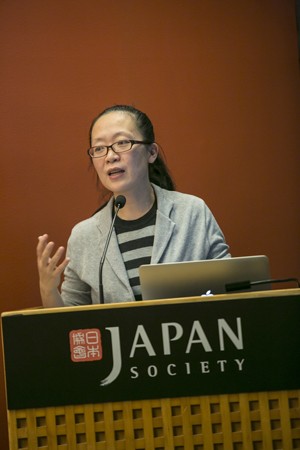
Jesse Winter
With its innovative approach to sustainable design, the new Cornell NYC Tech campus on Roosevelt Island will be more than another ivory tower, as its forward-leaning design has innovative building technologies. The Symposium on Resilient and Sustainable Built Environment at the Japan Society in New York City Nov. 15, sponsored by Cornell's Atkinson Center for a Sustainable Future, the Japan Foundation Center for Global Partnership and the University of Tokyo, focused on technology innovations and the needs of stakeholders to build with resiliency in mind and the capacity to adapt the built environment in the face of climate change and natural disasters in the low-carbon future, said the symposium's organizer Ying Hua, assistant professor of design and environmental analysis at Cornell's College of Human Ecology. A large part of the symposium focused on the sustainable building approach for the Cornell Tech campus. As the flagship building of the future 12-acre campus, the first academic building is being designed to generate as much energy from renewable resources as it will use from nonrenewable resources, said Kyu-Jung Whang, Cornell vice president for facilities services. This will be "a campus built for the next century." The campus will embody sustainability in its design, construction and operation, said Craig Gotsman, professor and founding director of the Joan and Irwin Jacobs Technion-Cornell Innovation Institute.
TO READ THIS ARTICLE, CREATE YOUR ACCOUNT
And extend your reading, free of charge and with no commitment.