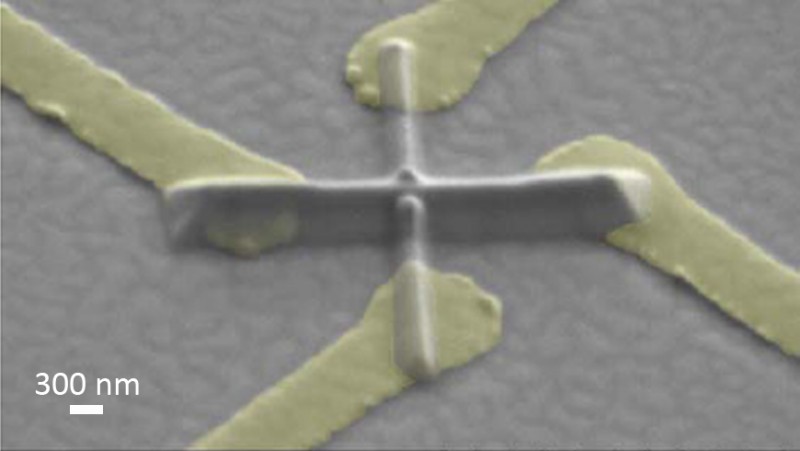
A magnetic sensor additively written with a focused electron beam and Co2(CO)8 molecules, located between four previously-structured gold electrodes. The sensor can be given any required shape by moving the substrate or adjusting the dwell time of the electron beam.
Nanotechnology is regarded as the key technology of the 21st century, delivering the fundamental methods, which allow objects just a few hundred nanometers in size to be produced in any required shape. These objects find applications practically everywhere - be it for microprocessors and electrical circuits in computers, in the telecommunications industry, or in medicine and biotechnology - to name just a few. To encourage the development of new manufacturing processes the EU recently established the Marie Curie Training Network "ELENA" (low energy electron-driven chemistry for the advantage of emerging nanofabrication methods). Empa is one of the project partners, together with 13 universities, three research institutes and five industrial partners, drawn from a total of 13 countries. The aim of this large-scale project is to provide training for young European scientists in the field of nanotechnology so that they can generate the innovative ideas necessary to further research and scientific exploitation, so enhancing Europe's international competitivity. The network is led by Oddur Ingólfsson of the Icelandic University in Reykjavík, Empa's representative is Ivo Utke from the Mechanics of Materials and Nanostructures laboratory in Thun. Empa was already involved in the predecessor project to "ELENA", the COST-Action Network "CELINA" (chemistry for electron-induced nanofabrication), where it worked closely with some of the universities now participating in the current project.
TO READ THIS ARTICLE, CREATE YOUR ACCOUNT
And extend your reading, free of charge and with no commitment.