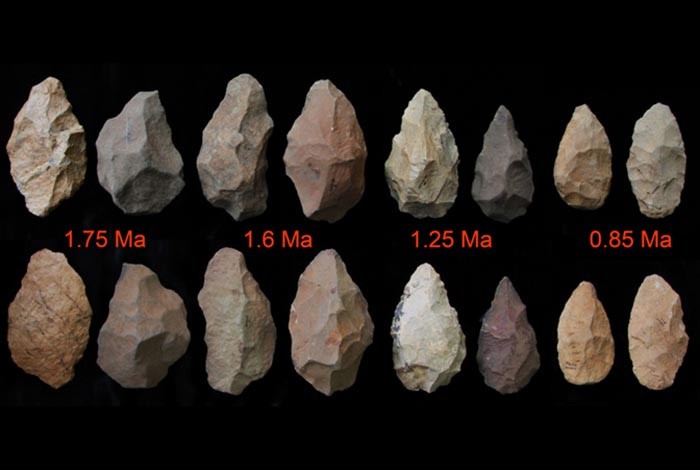
Ancient stone tools showing the pace of remarkable technological enhancements over time (1.75 to 0.85 million years ago). Credit, Los Alamos National Laboratory.
"Even though fossil remains of the tool makers are not commonly preserved, the handaxes clearly archive the evolution of innovation in craftsmanship, acquired intelligence and social behavior in a pre-human community over a million-year interval," said WoldeGabriel. Ancient handaxe craftsmanship gives insight into mental advances. LOS ALAMOS, N.M. March 12, 2013—LOS ALAMOS, N.M. March 12, 2013—Stone Age man's gradual improvement in tool development, particularly in crafting stone handaxes, is providing insight into the likely mental advances these early humans made a million years ago. Better tools make for better hunting, and better tools come from more sophisticated thought processes. Close analysis of bits of chipped and flaked stone from across Ethiopia is helping scientists crack the code of how these early humans thought over time. Los Alamos National Laboratory Fellow Giday WoldeGabriel and a team of Ethiopian, Japanese, American and German researchers recently examined the world's oldest handaxes and other stone tools from southern Ethiopia. Their observation of improved workmanship over time indicates a distinct advance in mental capabilities of the residents in the entire region, with potential impacts in tool-development skills, and in overall spatial and navigational capabilities, all of which improved their hunting adaptation.
TO READ THIS ARTICLE, CREATE YOUR ACCOUNT
And extend your reading, free of charge and with no commitment.