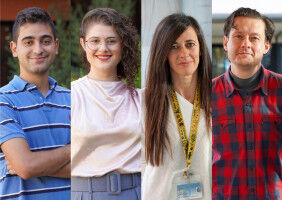
Early career reseachers decend on parliament
Last month the House of Commons hosted a group of early career researchers, including 16 from Imperial, who presented their science to politicians. As part of the SET for Britain event, held on 18 March, 180 presenters were entered into categories, namely engineering, biological and biomedical sciences, chemistry and physics after being shortlisted from hundreds of applicants. On presenting his research, Dr Davide Fabozzi (Chemical Engineering), a Marie Curie Experienced Research Fellow, said: "It was a unique opportunity. My research deals with one of the greatest challenges of our era: the integration of renewable energy resources. While my work addresses the scientific aspects of the problem, ultimately it is the politicians who set the policies for our future. I am hopeful that fruitful discussion may come from the interactions with MPs." Miss Inês Cecílio, a PhD candidate also in the Department of Chemical Engineering (pictured with Brian Iddon MP), presented a poster on her research into new signal analysis methods for monitoring the production of natural gas. "It's a chance to help demystify the idea of science as unreachable and inapplicable, and to draw the attention of our leaders and the wider public to the key role of scientific research to social and economic growth." Andrew Miller MP, Chairman of the Parliamentary and Scientific Committee, said: "These early career engineers are the architects of our future and SET for Britain is politicians' best opportunity to meet them and understand their work." SET for Britain was established by Dr Eric Wharton in 1997.