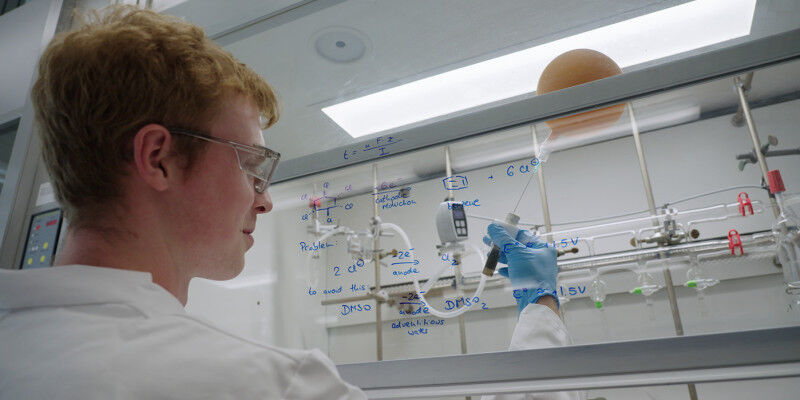
Researchers have developed a process that can be used on site to render environmental toxins such as DDT and lindane harmless and convert them into valuable chemicals - a breakthrough for the remediation of contaminated sites and a sustainable circular economy.
They were once considered miracle workers - insecticides such as lindane or DDT were produced and used millions of times during the 20th century. But what was hailed as progress led to a global environmental catastrophe: persistent organic pollutants (POPs) are so chemically stable that they remain in soil, water and organisms for decades. They accumulate in the fatty tissue of animals and thus enter the human food chain. Many of these substances were banned long ago, but their traces can still be found today - even in human blood.
How to remediate such contaminated sites, be they soils, bodies of water or landfills, is one of the major unresolved questions of environmental protection. How can highly stable poisons be rendered harmless without creating new problems? Researchers at ETH Zurich, led by Bill Morandi, Professor of Synthetic Organic Chemistry, have now found a promising approach. Using an innovative electrochemical method, they are not only able to break down these long-lived pollutants but also to convert them into valuable raw materials for the chemical industry.
Converting pollutants into raw materials
A key distinction between this and previous work is that the carbon skeleton of the pollutants is recycled and made reusable, while the halide component is sequestered as a harmless inorganic salt. "The previous methods were also energetically inefficient," says Patrick Domke, a doctoral candidate in Morandi’s group. He explains: "The processes were expensive and still led to outcomes that were harmful to the environment."
Together with electrochemistry specialist Alberto Garrido-Castro, a former postdoc in this group, Domke developed a process that renders the pollutants in question completely harmless. During this project, the two researchers were able to draw on the many years of experience of ETH professor Morandi, who has been working on the transformation of such compounds for years. "The key advance of this new technology is the use of alternating current to sequester the problematic halogen atoms as innocuous salts such as NaCl (table salt), while still generating valuable hydrocarbons," says Morandi.
Using electricity to break down toxins
Electrolysis enables almost complete dehalogenation of pollutants under mild, environmentally friendly and cost-effective conditions. It cleaves the stable carbon-halogen bonds, leaving behind only harmless salts such as table salt and useful hydrocarbons such as benzene, diphenylethane or cyclododecatriene. These are actually sought-after intermediates in the chemical industry, for example, for plastics, varnishes, coatings and pharmaceutical applications. In this way, the technology not only contributes to the remediation of contaminated sites but also to the sustainable circular economy.
"What makes our process so special from a technical point of view is that we supply electricity using alternating current, similar to the electrical waveform delivered to households. It is one of the most cost-effective resources in chemistry," explains Garrido-Castro. "Alternating current protects the electrodes from wear, which is why we can reuse them for many subsequent electrolysis cycles. In addition, the alternating current suppresses unwanted side reactions and the formation of poisonous chlorine gas, allowing the pollutant’s halogen atoms to be fully converted to inorganic salts." The reactor used by the researchers consists of an undivided electrolysis cell in which dimethyl sulfoxide (DMSO) is used as a solvent - itself a by-product of the pulp process in paper production.
A fully thought-out circular economy
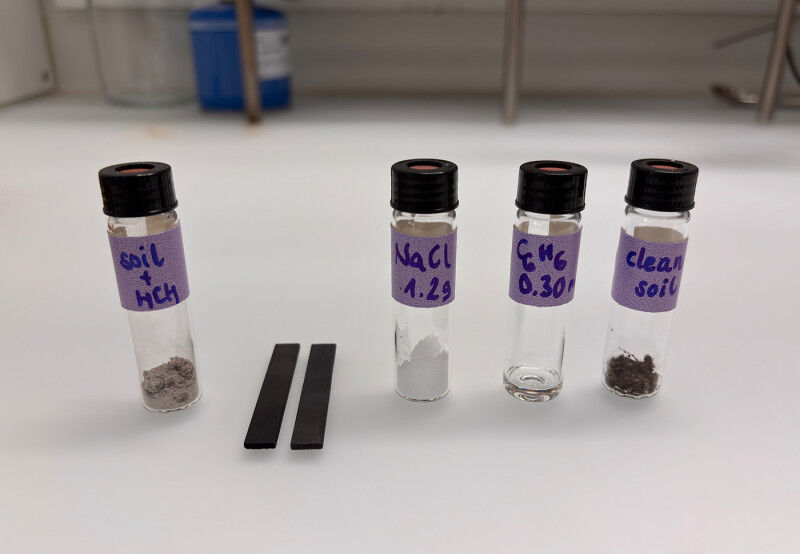
The process can be applied not only to pure substances but also to mixtures from contaminated soils. Soil or sludge can therefore be treated without pre-treatment or further separation processes. A prototype of the reactor has already been successfully tested on classic environmental toxins such as lindane and DDT. "Our system is mobile and can be assembled on site. This eliminates the need to transport these hazardous substances," explains Domke.
"Our motivation was to solve one of the biggest environmental problems of the last century. We cannot simply leave the pollution to future generations."
Spark Award 2025 - these projects have made it to the finals
On 27 November 2025 at ETH Zurich @ Open-i , ETH Zurich will award the Spark Award for the best invention of the year for the 14th time. The criteria for this award are originality, patent strength and market potential.
Click here to find all the Spark Award nominees of 2025.
Spark Award ceremony, Industry Day @ Open-i , Thursday, 27 November 2025, 1.30 p.m., Zurich Convention Center. Registration is required.