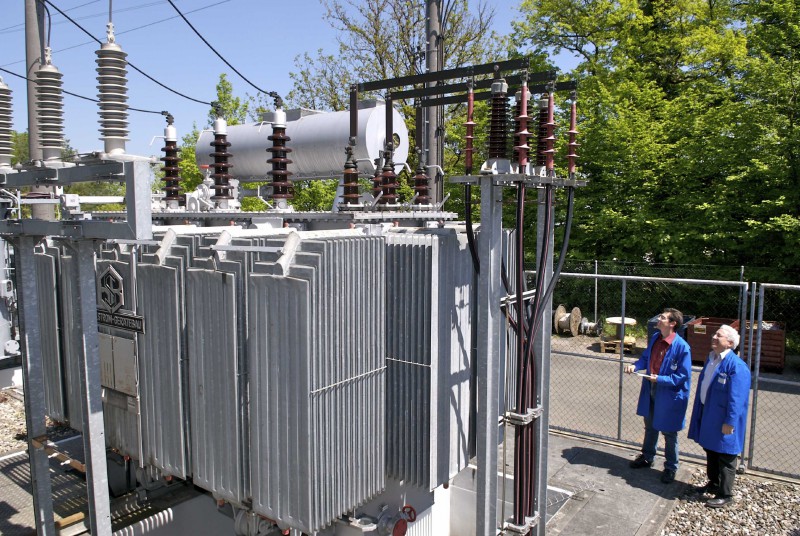
The Paul Scherrer Institute is supplied with electricity from a high-voltage power line at 50 kV. The transformer station shown on the image transforms the electrical voltage to 16 kV before distributing it within the institute. Further transformers situated throughout the institute reduce the voltage to 400 or 230 Volts. (Photo: Paul Scherrer Institute/Markus Fischer)
Researchers at the Paul Scherrer Institute PSI have found a way of looking inside the iron core of transformers. Transformers are indispensable in regulating electricity both in industry and in domestic households. The better their iron cores are magnetized, the less energy they lose and the more efficiently they work. The groundbreaking investigatory method of neutron grating interferometry developed at the PSI has opened up the possibility of observing magnetic domains at work as they establish magnetic fields inside the iron core. This is a significant step towards understanding how transformers work today and in the development of more efficient transformers in the future—not least because the EU has set new energy-efficiency targets in this field, which Switzerland has also agreed to. Researchers reported on their results in two studies published in the latest edition of the specialist journal Physical Review Applied . Transformers are an indispensable element in our electricity system: in substations, they transform voltage from low to high so that electricity can be distributed over long distances via high-voltage power lines without losing too much energy.
TO READ THIS ARTICLE, CREATE YOUR ACCOUNT
And extend your reading, free of charge and with no commitment.