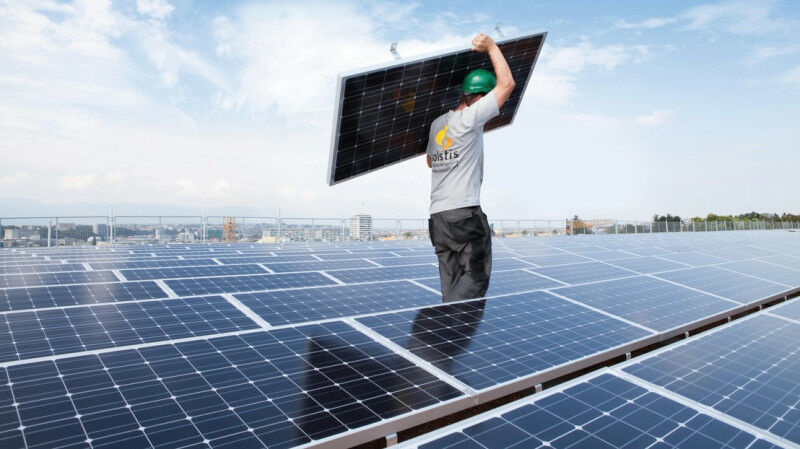
© 2023 Solstis - CC-BY-SA 4. Five million rooftops in Switzerland - more than half of the nationwide total - are suitable for generating power. A review of two solar photovoltaic development strategies has shown that combining the two approaches could cause over two-thirds of Swiss towns and cities to become energy self-sufficient. As part of its Energy Strategy 2050, the Swiss federal government is targeting a rapid expansion of the country's solar photovoltaic installed base, with an aim of generating 35 terawatt-hours (TWh) of power from renewables (excluding hydropower) in 2035, and 45 TWh in 2050. How can these goals be achieved in a way that's both efficient and fair to individual towns and cities? - Location and suitability of roofs to reach the next PV installation target according to the strategic expansion for all'inhabitable areas in Switzerland. EPFL / Alina Walch Martin Rüdisüli - CC-BY-SA 4. It's widely accepted that solar power will play a key role in decarbonizing Switzerland's energy mix - which is why rooftop energy potential has long been a research topic for scientists at the Solar Energy and Building Physics Laboratory (LESO-PB) within EPFL's School of Architecture, Civil and Environmental Engineering (ENAC).
TO READ THIS ARTICLE, CREATE YOUR ACCOUNT
And extend your reading, free of charge and with no commitment.
Your Benefits
- Access to all content
- Receive newsmails for news and jobs
- Post ads