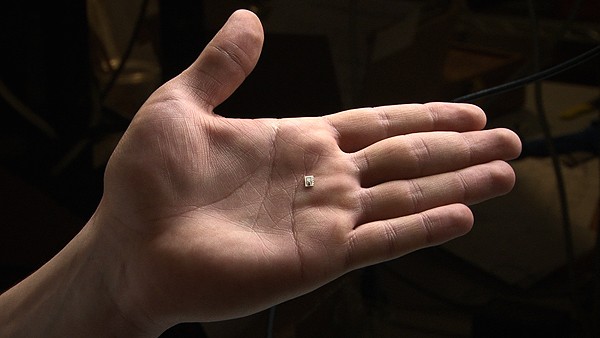
The current prototype chip, shown here resting on a hand, is only three millimeters wide and four millimeters long.
For 50 years, scientists searched for the secret to making tiny implantable devices that could travel through the bloodstream. Engineers at Stanford have demonstrated just such a device. Powered without wires or batteries, it can propel itself though the bloodstream and is small enough to fit through blood vessels. "While we have gotten very good at shrinking electronic and mechanical components of implants, energy storage has lagged in the move to miniaturize," said co-author Teresa Meng, a professor of electrical engineering and computer science. "This hinders us in where we can place implants within the body and also creates the risk of corrosion or broken wires, not to mention replacing aging batteries." Poon's devices are different. They consist of a radio transmitter outside the body sending signals inside the body to an independent device that picks up the signal with an antenna of coiled wire. The transmitter and the antennae are magnetically coupled such that any change in current flow in the transmitter produces a voltage in the other wire - or, more accurately, it induces a voltage.
TO READ THIS ARTICLE, CREATE YOUR ACCOUNT
And extend your reading, free of charge and with no commitment.