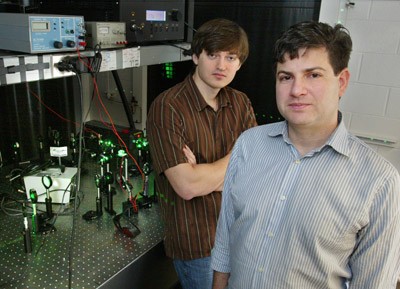
Jason Fleischer (right), a Princeton assistant professor of electrical engineering, and graduate student Dmitry Dylov have developed a new method for using nonlinear materials to reveal images of obscured objects. (Photo: Frank Wojciechowski)Images for news media
A new technique for revealing images of hidden objects may one day allow pilots to peer through fog and doctors to see more precisely into the human body without surgery. Developed by Princeton engineers, the method relies on the surprising ability to clarify an image using rays of light that would typically make the image unrecognizable, such as those scattered by clouds, human tissue or murky water. In their experiments, the researchers restored an obscured image into a clear pattern of numbers and lines. The process was akin to improving poor TV reception using the distorted, or "noisy," part of the broadcast signal. "Normally, noise is considered a bad thing," said Jason Fleischer , an assistant professor of electrical engineering at Princeton. "But sometimes noise and signal can interact, and the energy from the noise can be used to amplify the signal. For weak signals, such as distant or dark images, actually adding noise can improve their quality." He said the ability to boost signals this way could potentially improve a broad range of signal technologies, including the sonograms doctors use to visualize fetuses and the radar systems pilots use to navigate through storms and turbulence.
TO READ THIS ARTICLE, CREATE YOUR ACCOUNT
And extend your reading, free of charge and with no commitment.