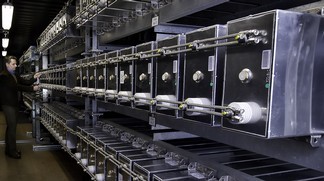
A new high-performance electrical system has been developed by the Industrial Electronics Laboratory at EPFL to ensure the particle accelerators of the CERN receive an energy supply that is both powerful and sufficiently stable. A new electricity supply system enabling the provision of all the necessary energy to the particle accelerators and their magnets has recently been commissioned at CERN. Within a few seconds, it can generate a current surge of 60 megawatts; the same combined power that 600 car engines at full throttle would produce. The result of cooperation with EPFL's Industrial Electronics Laboratory, this installation is essential for the smooth running of the experiments conducted in the various accelerators at CERN. These instruments - of which the most impressive and well-known is the Large Hadron Collider (LHC), 27km long, lying at 100 meters underground in the Geneva area - use electric or magnetic fields to raise the speed of the particles so that they are fully charged with energy, and to make them collide. They are used to study the ultimate components of matter within the framework of fundamental research in physics. The new electric system, called POPS - which stands for "POwer for PS" - supplies the proton synchrotron (PS).
TO READ THIS ARTICLE, CREATE YOUR ACCOUNT
And extend your reading, free of charge and with no commitment.
Your Benefits
- Access to all content
- Receive newsmails for news and jobs
- Post ads