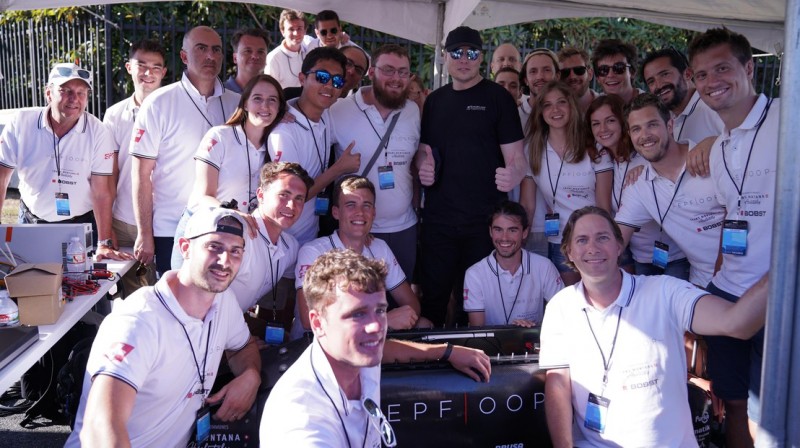
Using similar propulsion technology, the Hyperloop pods developed by EPFL and ETH Zurich turned in a solid performance in Los Angeles: EPFLoop topped out at 238 km/h in the airless tube set up by SpaceX, while Swissloop peaked at 259km/h. The Technical University of Munich hit a top speed of 463km/h, demolishing the record - and its capsule - in the process. For months the 21 student teams selected for the fourth edition of the SpaceX Hyperloop Pod Competition toiled away in secret, turning their bold ideas into unique solutions that could one day be the driving force behind a new means of transportation. Then came time to unveil their prototypes. It turns out that EPFL's team, dubbed EPFLoop, and Swissloop, the team composed of students from ETH Zurich and the Swiss Federal Laboratories for Materials Science and Technology, settled on the same type of propulsion system, a linear induction motor. They were the only ones to choose this type of motor, and they made the right decision. The conventional motor used by the Technical University of Munich (TUM) may have been faster - it reached a speed of 463 km/h - but the Swiss teams' pods proved more reliable. Unlike TUM's pod, the Swiss teams' machines remained physically intact after reaching speeds of 238km/h (for EPFLoop) and 259 km/h (for Swissloop). "We're disappointed with the outcome, of course," says Martin Seydoux, the EPFLoop captain. "But we're happy that our pod, Bella Lui , functioned exactly as expected. In all the tests we ran over the past week, up to the very last minute, the performance indicators were right in line with our predictions." So what went wrong?
TO READ THIS ARTICLE, CREATE YOUR ACCOUNT
And extend your reading, free of charge and with no commitment.
Your Benefits
- Access to all content
- Receive newsmails for news and jobs
- Post ads