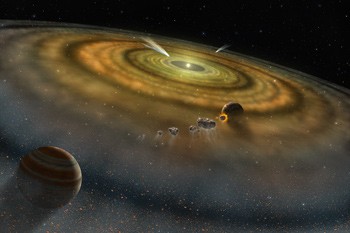
Artistic depiction of dust and comets around the young star Beta Pictoris as seen from the outer edge of its disk. NASA image by Lynette Cook.
Comets trailing wispy tails across the night sky are a beautiful byproduct of our solar system's formation, icy leftovers from 4.6 billion years ago when the planets coalesced from rocky rubble. The discovery by astronomers at the University of California, Berkeley, and Clarion University in Pennsylvania of six likely comets around distant stars suggests that comets - dubbed "exocomets" - are just as common in other stellar systems with planets. Though only one of the 10 stars now thought to harbor comets is known to harbor planets, the fact that all these stars have massive surrounding disks of gas and dust - a signature of exoplanets - makes it highly likely they all do, said Barry Welsh, a research astronomer at UC Berkeley's Space Sciences Laboratory. "This is sort of the missing link in current planetary formation studies," Welsh said. "We see dust disks - presumably the primordial planet-forming material - around a whole load of stars, and we see planets, but we don't see much of the stuff in between: the asteroid-like planetesimals and the comets. Now, I think we have nailed it. These exocomets are more common and easier to detect than people previously thought." Welsh will present the findings on Monday, Jan.
TO READ THIS ARTICLE, CREATE YOUR ACCOUNT
And extend your reading, free of charge and with no commitment.