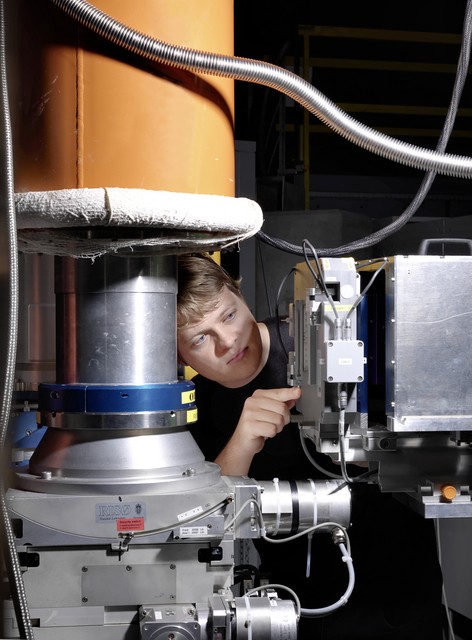
Jonathan White, first author on the paper, conducting an experiment on the neutron source SINQ at the PSI. (Photo: Scanderbeg Sauer Photography)
Media Releases Matter and Material Materials Research Researchers from the Paul Scherrer Institute (PSI) have made thin, crystalline layers of the material LuMnO3 that are both ferromagnetic and antiferromagnetic. These layers were grown on a non-magnetic carrier crystal. The LuMnO3 layer is ferromagnetic directly next to the interface with the carrier crystal. As the distance increases, it assumes the material's normal antiferromagnetic order while the ferromagnetism steadily becomes weaker. The ferromagnetism occurs because LuMnO3 adapts to the structure of the carrier crystal as the layers grow. This leads to distortions in the crystalline structure of LuMnO3, where the now partly ferromagnetic order is preferred. Layered structures with different magnetic orders are already used in various electronic devices today.
TO READ THIS ARTICLE, CREATE YOUR ACCOUNT
And extend your reading, free of charge and with no commitment.